
The 23–25 September state visit produced process rather than rules: an AI dialogue with a further round in November, a channel for AI-related incidents, and tariff recommendations covering about US$30bn of goods each way. No binding AI agreement emerged, and Taiwan appeared in neither side's readout.
The development that matters more to allocators predates the summit. The COINS Act, signed in December 2025, put outbound investment screening into statute and widened its scope, though rulemaking for the new sectors may not take effect until March 2027.
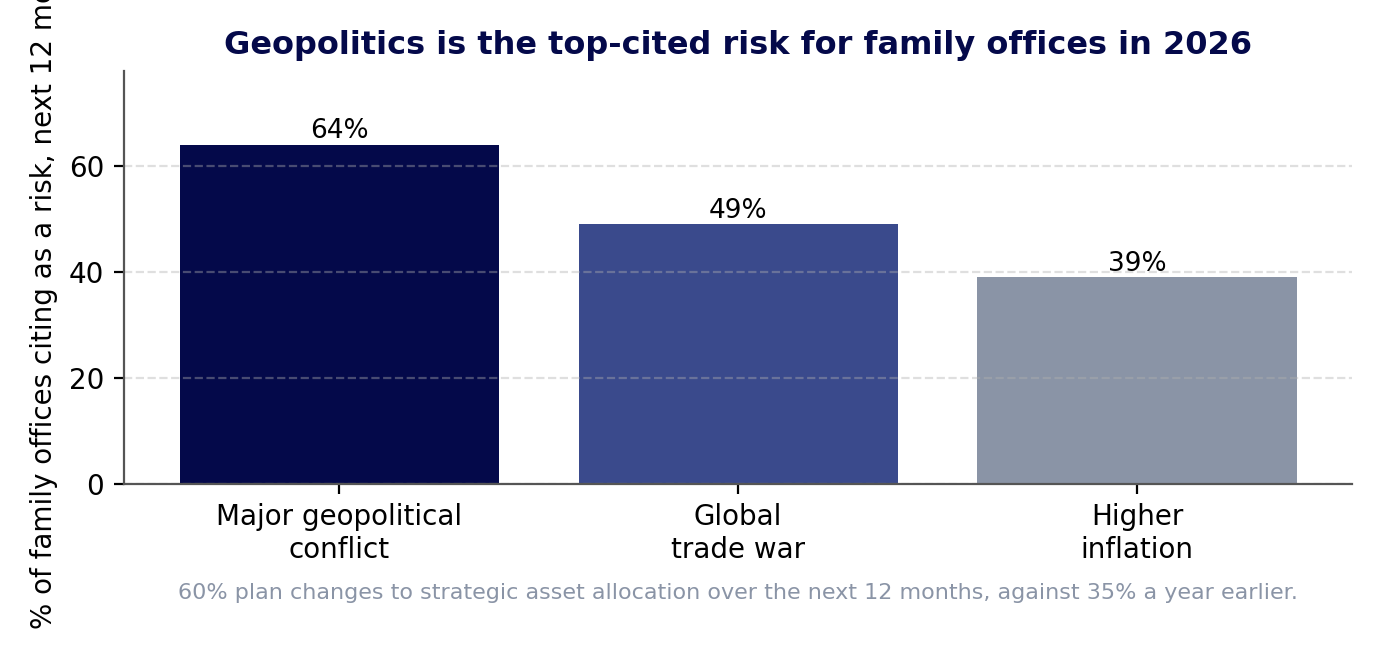
Family offices already treat this as the central risk: 64% name major geopolitical conflict as their principal concern for the coming year, and 60% plan changes to strategic asset allocation (UBS).
Xi Jinping's state visit to Washington from 23 to 25 September was the second of four scheduled leader-level meetings between the United States and China this year, and the first US state visit by a Chinese leader in more than a decade. It was heavy on ceremony: the US president met his counterpart at the airport, and more than a hundred guests attended a state dinner. For investors in private technology, the substance matters more than the staging, and the substance was thinner than the billing.
What the summit actually produced
On trade, the two governments reached consensus on recommendations for more favourable tariff treatment covering roughly US$30bn of non-sensitive goods in each direction, together with a Chinese commitment to buy American coal and a working group on agricultural trade. On artificial intelligence, the outcome was procedural: an agreement to hold a formal dialogue on the technology's risks and benefits, with the next round set for November, and a channel through which each government can notify the other of AI-related incidents serious enough to raise national security concerns. No framework, no safety pact, no joint statement on AI.
Analysts at the Center for Strategic and International Studies, whose China programme tracked the summit closely, characterised the deliverables across trade, rare earths, refined oil, investment and AI as limited and tentative, and noted that although Taiwan was discussed it did not appear in either side's official readout, which suggests no progress on that question. CSIS's broader assessment was that the meeting revealed how little movement there has been on the most consequential dimensions of the relationship: AI, cyber operations, export controls and digital sovereignty.
Table 1: Summit deliverables and what they change
| Area | Outcome | Significance for allocators |
|---|---|---|
| Tariffs | Consensus on recommendations for more favourable treatment of ~US$30bn of non-sensitive goods each way, through a newly formed Board of Trade | Incremental; does not touch technology sectors subject to export controls or investment screening |
| Artificial intelligence | Agreement to hold a dialogue on risks and benefits, next round in November, plus an incident notification channel | Establishes a talking mechanism, not a rulebook; neither government accepted constraints on its own developers |
| Rare earths | Discussed; no new binding commitment disclosed in the readouts | The suspension of China's harshest export rules is on a separate clock (see below) |
| Taiwan | Discussed but absent from both readouts | The principal tail risk for semiconductor supply remains entirely unresolved |
| Investment screening | Not reopened | US outbound rules and Chinese approval requirements continue to operate independently of the summit |
One point of language is worth correcting, because it has circulated widely. The phrase “super intelligence” was the US president's framing, used before and during the meeting; reporting of the summit noted that Xi did not adopt it, speaking instead about keeping AI development under human control. The rhetorical gap is not cosmetic. It reflects two governments that agree on very little about this technology beyond a shared reluctance to have anyone regulate their own developers.
The calendar matters more than any single meeting
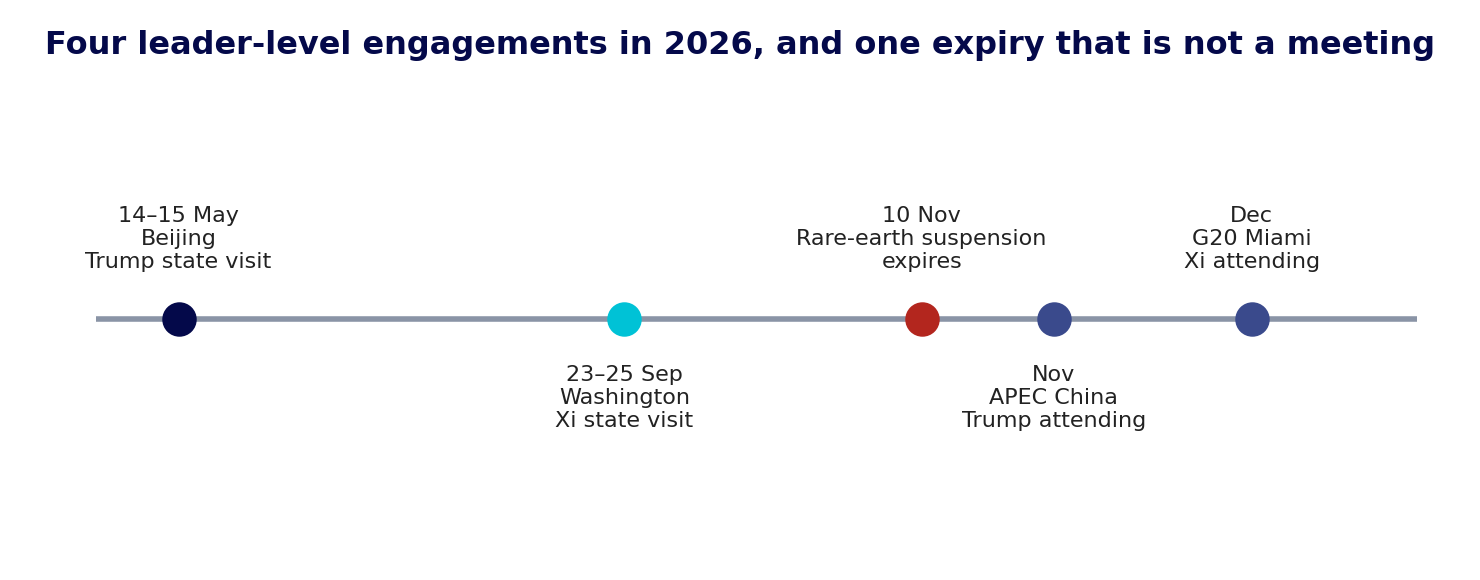
Treating the Washington visit as a decisive turning point misreads the sequence. It was the second of four planned engagements in 2026: the US president made a state visit to Beijing in May, APEC is hosted by China in November, and the G20 meets in Miami in December. Each carries the possibility of incremental announcements, and none has so far produced a structural settlement.
The date investors should mark is not a summit at all. China's suspension of its harshest rare-earth export rules, agreed in late 2025, runs on a one-year timer that expires on 10 November 2026. Whether that suspension is extended, allowed to lapse or replaced will tell allocators more about the trajectory of the relationship than any communiqué.
Figure 1 | The 2026 engagement calendar
Source: summit reporting from NBC News (23 Sep 2026), CNN (24 Sep 2026) and CNBC (28 Sep 2026); rare-earth suspension timing as reported in trade coverage. Chart: Argent Bluebook.
The rulebook that moved was not written at a summit
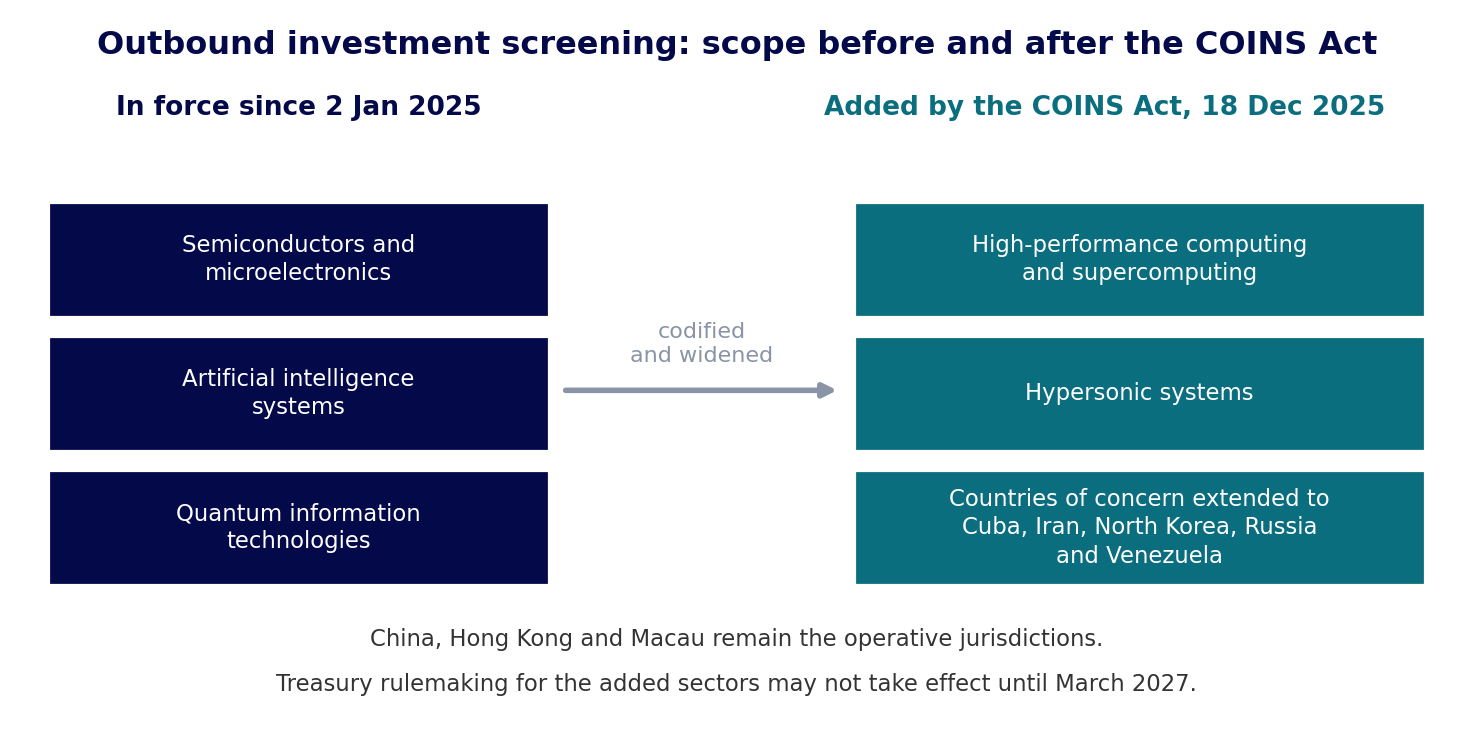
For anyone allocating capital across this divide, the material change of the past year came from Congress rather than from diplomacy. The Comprehensive Outbound Investment National Security Act, enacted within the FY2026 National Defense Authorization Act on 18 December 2025, put the Outbound Investment Security Program into statute. That programme had been running since 2 January 2025 under executive authority; codification makes it a durable feature of the regulatory landscape rather than an instrument that changes with an administration.
The Act also widened the perimeter, adding high-performance computing, supercomputing and hypersonic systems to the existing sectors of semiconductors and microelectronics, AI systems and quantum information technologies. It extended the list of countries of concern beyond China, Hong Kong and Macau to Cuba, Iran, North Korea, Russia and Venezuela, although comprehensive sanctions already restrict US investment in most of those, so the practical centre of gravity remains China. Two features deserve attention from anyone building a compliance calendar: Treasury rulemaking for the newly added sectors may not take effect until March 2027, and the national emergency underpinning the existing programme has been renewed into August 2027. The rules in force today are not the rules that will be in force at the end of the decade.
Figure 2 | Outbound investment screening: scope before and after the COINS Act
Source: Latham & Watkins, Davis Polk, Cleary Gottlieb and Torys client alerts on the COINS Act (Dec 2025 – Jan 2026); Congressional Research Service IF12629 (updated Mar 2026). Chart: Argent Bluebook.
It is worth being precise about how the programme works, because it is frequently described in broader terms than it deserves. The regime is two-tier: some transactions are prohibited, others merely notifiable. There is no case-by-case review comparable to CFIUS, and Treasury has described its approach as narrowly scoped, targeting investments likely to convey both capital and intangible benefits — expertise, networks, validation — rather than all exposure to Chinese technology. Exceptions exist for certain passive positions, including defined categories of limited partner interests. A blanket statement that any US investor in a foreign fund is exposed to enforcement if that fund touches Asian technology is not an accurate description of the rules, and investors who plan around that caricature will misallocate compliance effort. The correct approach is a transaction-level analysis with counsel, against the technical parameters of the covered activities.
China screens in the other direction
The barrier is not one-sided, which is the part most Western commentary underplays. Chinese authorities have their own approval requirements for foreign participation in strategic technology assets: reporting this year indicates that the National Development and Reform Commission required government sign-off for foreign investment in ByteDance and Moonshot AI, and blocked at least one foreign acquisition of a Chinese AI company. Separately, mainland exchanges have opened pre-profit listing routes for AI and quantum companies, which gives Chinese developers a domestic capital pathway that does not depend on foreign money at all.
The strategic logic is symmetrical. Washington restricts capital going out; Beijing controls who may come in and is building the onshore funding channels to make the question less pressing. For an offshore allocator, that means access to the best Chinese assets may be constrained by Chinese policy as much as by American rules — and that a structure designed purely to satisfy one side may still fail at the other.
Semiconductors: a currency, not a wall
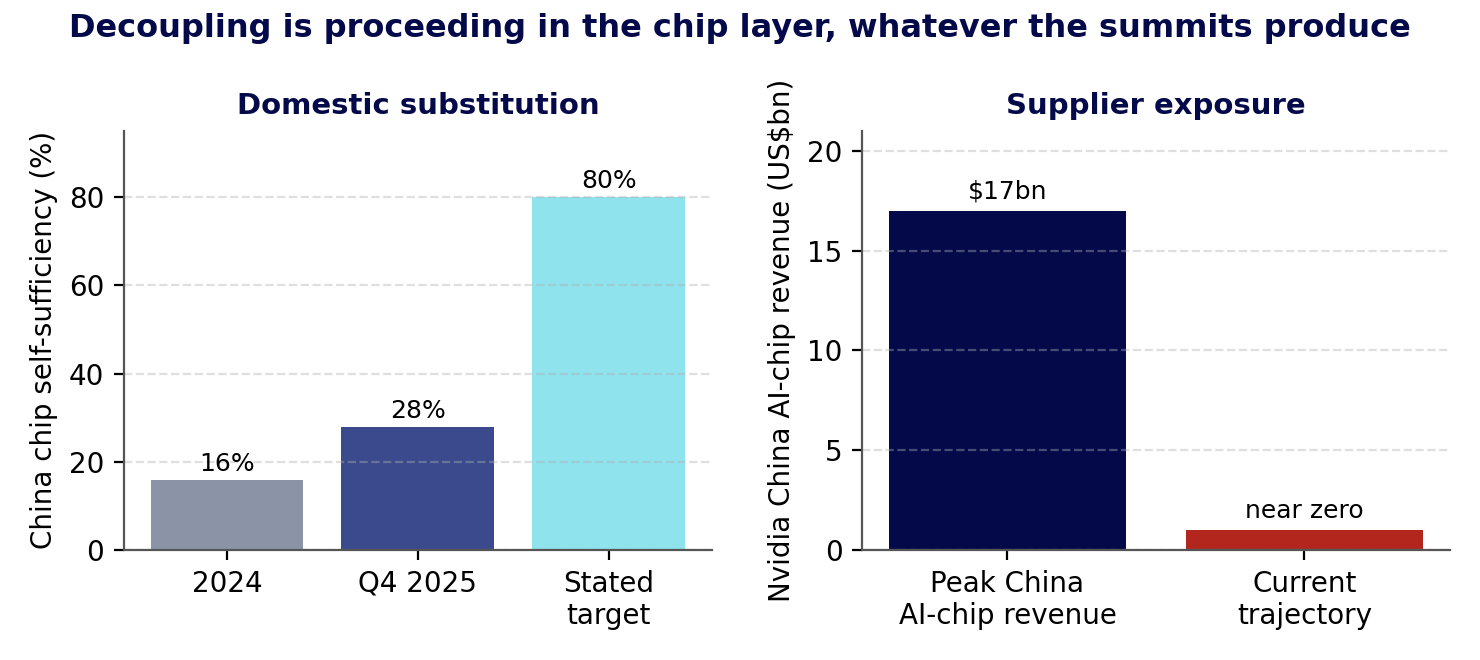
The chip layer is where decoupling is actually being priced. China's domestic chip self-sufficiency has been reported rising from roughly 16% in 2024 to about 28% by the fourth quarter of 2025, against a stated national target of 80%, supported by very large state subsidies. On the other side of the ledger, Nvidia's China AI-chip revenue has fallen from a peak near US$17bn toward negligible levels under successive licensing regimes, tariff arrangements and Chinese discouragement of US chip purchases.
Figure 3 | Substitution and exposure in the chip layer
Source: figures as reported in industry analysis of 2026 export-control policy, drawing on company disclosure and Chinese production data; self-sufficiency and revenue figures are reported estimates rather than audited data. Chart: Argent Bluebook.
The more interesting development is qualitative. Export controls began as a prohibition and have become a negotiation: licences granted subject to revenue-sharing arrangements, chips approved in Washington then discouraged at the Chinese border, and restrictions suspended rather than repealed. For investors, a policy that is traded rather than fixed is harder to underwrite than one that is simply restrictive, because the range of outcomes widens in both directions and the timing is political.
What allocators are actually doing
The survey evidence suggests measured adjustment rather than retreat. UBS's Global Family Office Report 2026, covering 307 family offices across more than 30 markets with an average net worth of US$2.7bn, found major geopolitical conflict cited as the leading risk for the coming year by 64% of respondents, ahead of a global trade war at 49% and higher inflation at 39%. Sixty percent plan to change strategic asset allocation over the next twelve months — the highest reading UBS has recorded, against 35% a year earlier — and 65% expect confidence in the dollar's reserve status to weaken.
Figure 4 | What family offices say they are worried about
Source: UBS Global Family Office Report 2026, published 28 May 2026; 307 family offices surveyed between 22 January and 30 March 2026. Chart: Argent Bluebook.
Yet AI remains a leading investment theme, alongside power and resources at 50% and automation and robotics at 44%, and regional appetite varies sharply: family offices in Southeast Asia lead global adoption of the AI theme, while US offices retain the strongest home-market bias, with 88% of portfolios in North America. The pattern is not capital fleeing the theme because of geopolitics. It is capital staying in the theme and becoming more selective about where, and through what structure, it takes the exposure.
Implications for private-market access
Three observations follow for investors considering private technology exposure across this divide.
- Jurisdiction is the first question, not the last. Whether a given investor may hold a given asset depends on the investor's nationality and control, the target's covered activities, the instrument used and the approvals required on both sides. That analysis belongs at the start of a process, with counsel, because it determines whether a transaction is possible at all.
- No venue or structure creates an exemption. Regulated intermediaries can standardise documentation, verify identity and beneficial ownership, hold funds in escrow and evidence a compliance trail. None of that changes what a screening regime prohibits. Any description of market infrastructure that implies capital can move across restricted borders without engaging those rules should be treated as a warning sign rather than a feature.
- Issuer consent remains the binding constraint in single-company trades. Whatever the regulatory position, most late-stage private companies control their own registers through transfer restrictions, rights of first refusal and board consent. A transaction that clears every government test can still fail at the company's door.
Signals to watch
Table 2: What would indicate a genuine change of direction
| Signal | Timing | What it would show |
|---|---|---|
| Whether the November AI dialogue produces anything beyond a further meeting | November 2026 | Whether the incident channel becomes a substantive mechanism or remains symbolic |
| Extension or lapse of China's rare-earth suspension | 10 November 2026 | The clearest single read on whether the truce is durable |
| Treasury rulemaking on the added COINS Act sectors | Into March 2027 | The practical perimeter for US investors later this decade |
| Outcomes at APEC in China and the G20 in Miami | November and December 2026 | Whether the meeting cadence produces substance or only continuity |
| Chinese approval practice for foreign investment in leading AI developers | Ongoing | Whether inbound access narrows further as onshore listing routes mature |
The summit did not resolve the questions that matter to cross-border technology investors, and it was not really designed to. What it confirmed is that both governments intend to keep meeting, keep competing and keep the rules of the AI race to themselves. For allocators, the practical consequence is unglamorous: the constraints are statutory, they are moving on their own timetable, and they are best handled as a diligence discipline rather than a market view.