
Anthropic's May 2026 Series H raised US$65bn at a US$965bn post-money valuation, on then-reported run-rate revenue of US$47bn.
Reported run-rate reached US$65bn by the end of July, with quarterly revenue above US$11.5bn — roughly 14 times the same quarter a year earlier.
The company has restricted secondary transfers, so third-party quotes are a poor guide to its value; primary rounds remain the only firm reference.
When allocators discuss the price of frontier AI, one company now anchors the conversation. Anthropic's valuation has risen from US$183 billion in September 2025 to US$965 billion in May 2026, and its reported revenue has grown faster still. Both the numbers and their provenance deserve scrutiny, because the benchmark is being used to price assets far beyond the company itself.
The marks
Anthropic raised US$13 billion at a US$183 billion post-money valuation in September 2025 [1]. A Series G of about US$30 billion at US$380 billion followed in February 2026 [2]. In May 2026 the company announced a US$65 billion Series H at a US$965 billion post-money valuation, co-led by investors including Singapore's GIC, with Temasek and MGX among significant participants [3]. Each figure is a negotiated price for newly issued preferred stock, disclosed by the company.
The revenue trajectory
Growth, not multiple expansion alone, drove those marks. Anthropic's annualised run-rate revenue was about US$9 billion at the end of 2025 and roughly US$47 billion when the Series H was announced [3]. Bloomberg reported in August 2026 that the run rate had passed US$65 billion by the end of July, with preliminary quarterly revenue above US$11.5 billion against US$787 million in the same quarter a year earlier, and positive adjusted operating income for the quarter [4]. Axios and CNBC corroborated the figure the same day [5][6].
Figure 1: Anthropic reported annualised run-rate revenue
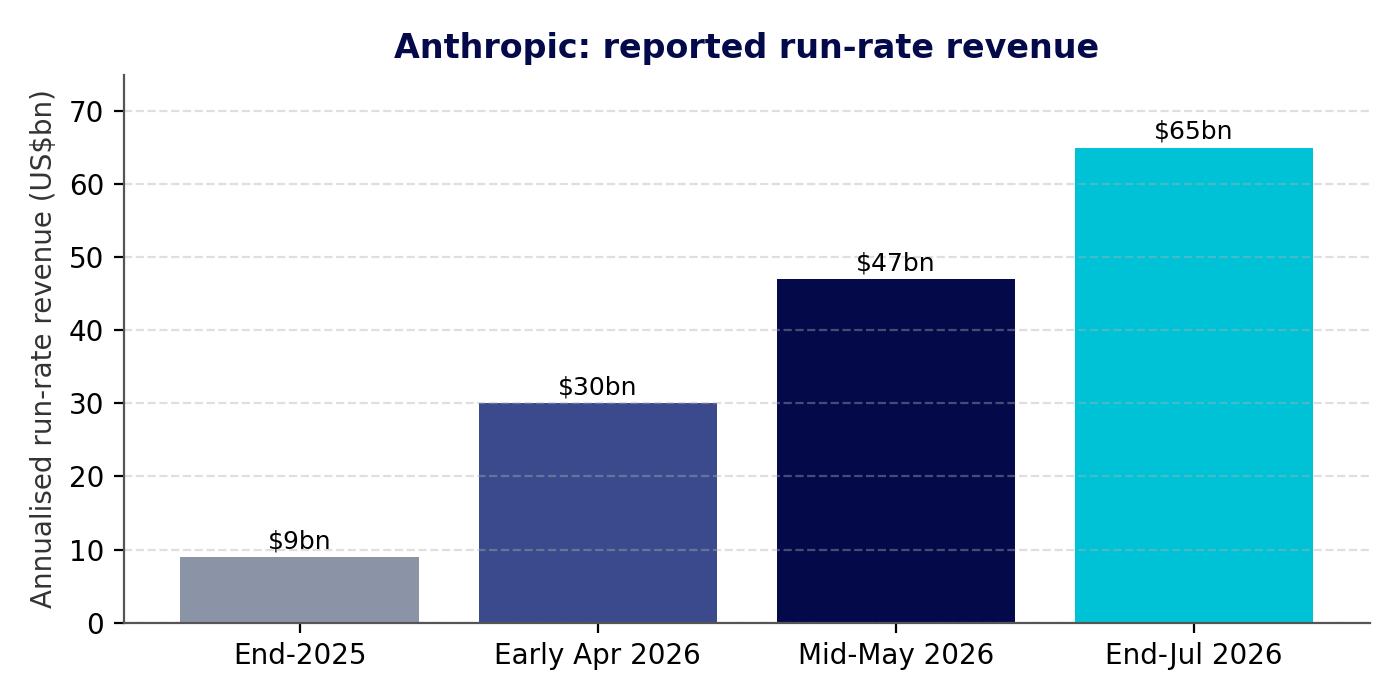
Source: Anthropic (Series H announcement, 28 May 2026) [3]; Bloomberg, Axios and CNBC (17 Aug 2026) [4][5][6]. A run rate annualises a short recent period and is not audited annual revenue. Chart: Argent Bluebook.
Two cautions belong with those numbers. A run rate extrapolates a short period and is not audited revenue; Anthropic's own most recent official figure remains the US$47 billion cited with the Series H. And the later figures come from reporting of investor updates rather than company announcements.
What the multiple implies
On the May round's valuation of US$965 billion against the then-current US$47 billion run rate, the implied multiple is roughly 20 times. Measured against the US$65 billion run rate reported for July, it falls to about 15 times. Both are calculations on a forward-looking metric, not on profits, and they assume continued growth at a pace few companies have sustained. Investors quoted by the Financial Times reportedly expect the company to finish 2026 between US$100 billion and US$120 billion of run-rate revenue [7] — an expectation, not a result.
Why secondary quotes are unreliable here
Anthropic is unusual among benchmark names in how tightly it controls its register. In May 2026 it stated that any sale or transfer of its stock, or of any interest in its stock, not approved by its board is void, that it does not permit special purpose vehicles to hold its shares, and that a number of platforms offering access were unauthorised [8][9]. Quoted prices in venues the company does not recognise therefore describe demand for an unapproved contract rather than the value of a share the issuer will register.
Risks the benchmark does not capture
Concentrated benchmarks obscure company-specific risk. Anthropic's growth in 2026 came alongside notable disruptions, including a Pentagon supply-chain risk designation and a temporary withdrawal of two of its most capable models to comply with a government export-control directive, with access restored after roughly two weeks [6]. The general point applies to every frontier developer: policy, compute supply and customer concentration are live variables, and a single private mark prices none of them explicitly.
Using the benchmark properly
- Treat the primary round as the firm reference and note its date; at this growth rate a mark is stale within months.
- Distinguish run-rate revenue from annual revenue, and reported figures from company-confirmed ones.
- Do not apply one company's multiple to another without adjusting for growth, margin and customer mix.
- Check whether a quoted secondary price corresponds to a transfer the issuer would recognise.
Anthropic has confidentially filed for a public listing and is reported to be preparing to come to market as soon as this autumn [4]. If it does, the benchmark used across the sector will move from a company-set private mark to a continuously tested public one — a more informative reference, and probably a more volatile one.