
ByteDance's AI drug-discovery unit Anew Labs raised US$290m at a US$1.5bn valuation in its first external round, with ByteDance retaining 56% (Reuters).
Asia's AI liquidity has run through listings rather than secondaries: Zhipu and MiniMax raised a combined US$1.2bn in Hong Kong in January.
Asia-Pacific accounted for a small share of global secondary volume in H1 2026, so carve-outs and IPOs, not secondary trading, are the region's main liquidity route.
Corporate carve-outs have become one of Asia's most active routes for creating independent technology companies. The latest example arrived this week, and it illustrates both the appeal of the structure and the reasons investors should read these transactions carefully.
The Anew Labs transaction
Reuters reported on 16 September 2026 that ByteDance had completed a US$290 million fundraising for Anew Labs, its AI drug-discovery unit, after spinning it out of the group. The round valued the Shanghai-headquartered company at about US$1.5 billion and was led by HSG — formerly Sequoia China — with IDG Capital and Hillhouse Investment, and 5Y Capital as co-lead. Gaorong Ventures, Primavera Venture Partners and Boyu Capital participated, alongside strategic investor SBP Group and the state-backed Shanghai Future Industries Fund. ByteDance retains a 56% stake [1][2].
The business originated in an internal AI-for-science team and develops platforms for biomolecular structure prediction, molecular design and antibody design, with offices in Shanghai, Singapore and San Francisco [1]. It enters a well-capitalised field: Isomorphic Labs, spun out of Google DeepMind, raised a US$2.1 billion round earlier this year [3].
Why groups carve out
The logic is consistent across the region. A unit inside a large group competes for internal budget, cannot issue its own equity to recruit specialists, and is valued by the market as part of the parent. Separating it creates a dedicated capitalisation table, brings in outside investors who price the business on its own prospects, and allows equity incentives tied to its performance. For the parent, retaining a majority stake preserves control and any upside while transferring part of the funding burden.
What an investor is buying
- A controlled company. With the parent at 56%, minority investors depend on protections negotiated in the documents, not on voting power.
- Continuing dependence. Carve-outs frequently rely on the parent for compute, data or services; the terms of those arrangements affect economics and are not usually public.
- A long development cycle. A drug-discovery platform is valued on scientific milestones, not on software adoption curves. The round is capital, not validation.
- Restricted transferability. Shares in a controlled private company typically carry consent requirements at least as strict as those of a standalone start-up.
Where Asian liquidity is actually coming from
The region's route to liquidity in 2026 has run mainly through public markets, not secondaries. In January, two Chinese large-language-model developers listed in Hong Kong within a day of each other: Zhipu AI raised US$558 million and rose 13% on debut, while MiniMax raised US$620 million and closed 109% higher, valuing it at about US$13.7 billion [4][5]. By contrast, Evercore's data show Asia-Pacific and the rest of the world accounting for just 2% of GP-led secondary volume by portfolio-company geography in the first half of 2026 [6].
ByteDance itself
The parent remains the region's largest private valuation reference. Its implied value has been set through a sequence of private transactions rather than a market: an employee buyback at more than US$330 billion, a secondary transaction at US$480 billion in November 2025, and a proposed stake sale by General Atlantic in February 2026 at about US$550 billion [7].
Figure 1: ByteDance implied valuations from reported private transactions
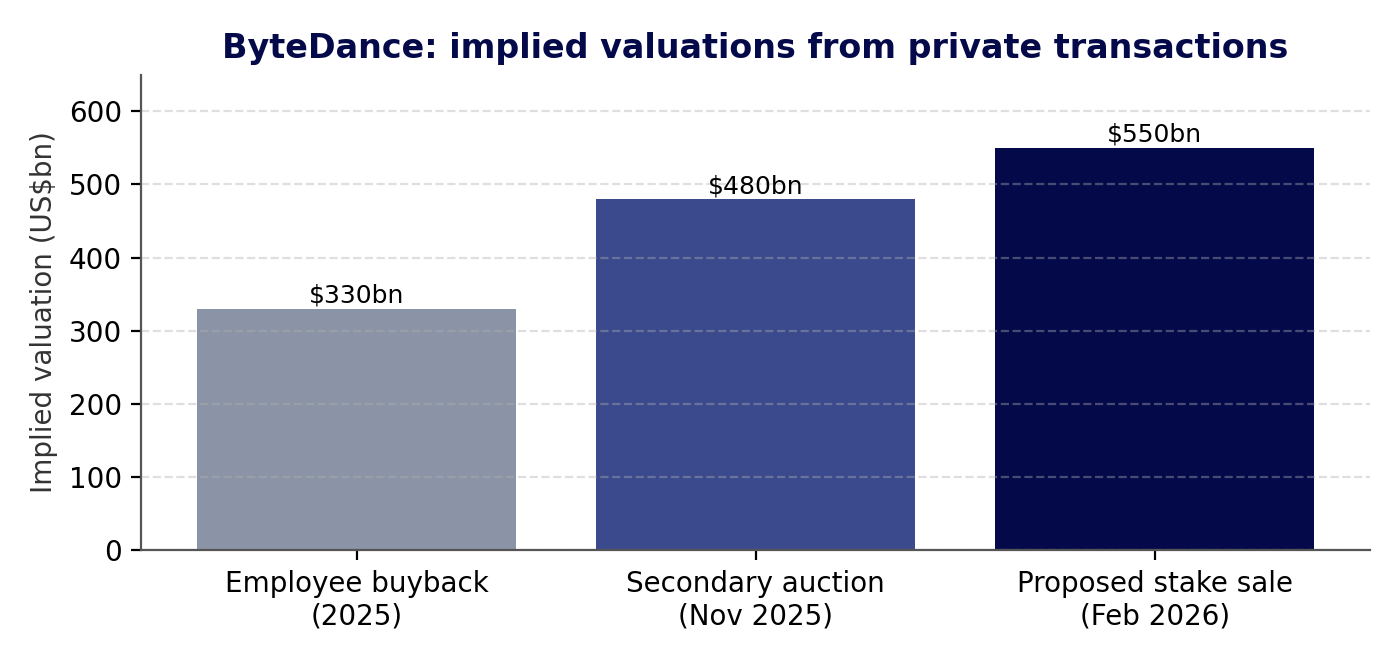
Source: Reuters, February 2026 [7]. Each mark comes from a different transaction type; proposed sales may not complete. Chart: Argent Bluebook.
The cross-border overlay
For non-Chinese investors, these opportunities sit inside a regulatory frame that has to be checked before price is discussed. The US Outbound Investment Security Program has since January 2025 prohibited or required notification of certain investments by US persons in AI, semiconductor and quantum businesses connected to China, including Hong Kong and Macau [8][9]. Structures typically involve offshore holding companies, and both the tax and the regulatory analysis differ from a US transaction. Specialist advice is essential, and it belongs at the start of the process rather than at signing.