
Secondary volume reached US$240bn in 2025 on Jefferies' count, up 48%, with LP-led and GP-led transactions both at records.
Private rounds have grown large enough to fund companies that once needed public markets — but the IPO route is reopening, not closing.
Hong Kong's January listings of two Chinese AI developers, and SpaceX's stated 2026 IPO preparations, cut against the “private forever” thesis.
For most of the past five years the dominant story in private markets was companies staying private for longer and using secondaries instead of listings. The 2025 data show why that story took hold — and the first quarter of 2026 shows why it should not be taken too far.
The secondary market's record year
Jefferies counted US$240 billion of global secondary volume in 2025, a 48% increase, split between US$125 billion of LP-led and US$115 billion of GP-led transactions [1]. Evercore, on its own methodology, counted US$226 billion [2]. Whichever figure is used, the market roughly doubled in three years, and it now functions as a standing liquidity channel rather than a distressed outlet.
Figure 1: Secondary transaction volume by segment, 2024 and 2025
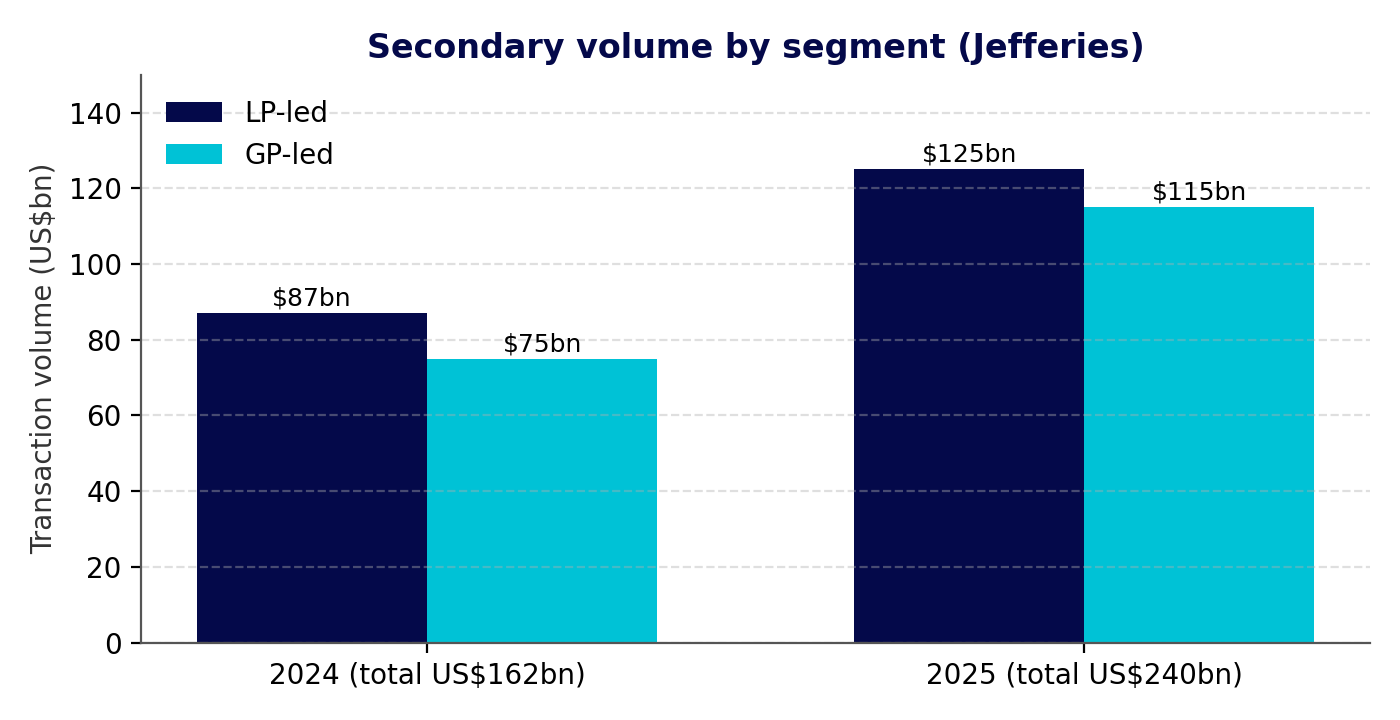
Source: Jefferies Private Capital Advisory, 2025 Global Secondary Market Review (10 Feb 2026) [1]. Chart: Argent Bluebook.
Why capital stayed private
Two forces did most of the work. Late-stage private rounds became large enough to fund extraordinary capital needs — the largest AI developers raised tens of billions of dollars privately during 2025 and early 2026 [3]. At the same time, allocators kept building private-market programmes: J.P. Morgan Private Bank's 2026 survey found that 65% of family offices intend to prioritise AI investments, while noting that many have limited exposure to the growth equity and venture segments where that value is being created privately [4].
The counter-evidence
The “stay private forever” thesis nonetheless looks weaker at the start of 2026 than it did a year earlier. In December 2025, SpaceX set an US$800 billion valuation in an insider share sale and told shareholders it was preparing for a possible public offering in 2026 [5]. In January, two Chinese large-language-model developers listed in Hong Kong within a day of each other: Zhipu AI raised US$558 million and MiniMax US$620 million, the latter closing 109% above its offer price [6]. Public markets, in other words, are available again to companies that want them.
What the secondary market actually replaced
The more accurate reading is that secondaries have replaced a specific function of the IPO — periodic liquidity for employees and early investors — rather than the listing itself. Company-run tender offers and GP-led continuation vehicles let shareholders realise value without a public listing, but they do not provide permanent capital, an acquisition currency, or a liquid market for future investors.
Table 1: What each route provides
| Function | Secondary market | Public listing |
|---|---|---|
| Liquidity for existing holders | Yes, periodic and capped | Yes, continuous after lock-up |
| New capital for the company | No (except company buybacks) | Yes |
| Acquisition currency | No | Yes |
| Price discovery | Partial and private | Continuous and public |
| Disclosure obligations | Limited | Extensive and ongoing |
Source: Argent Bluebook.
Implications
For allocators, the practical consequence is that entry point matters more than narrative. A company that raises privately at scale and then lists has two distinct pricing regimes, and the transition between them has repriced assets in both directions. For the secondary market, the 2026 listing pipeline is less a threat than a change of role: from a substitute for the IPO to the market that operates on either side of it.