
Confidentiality and verification are routinely treated as a trade-off. In public markets they are not: a custodian confirms a holding every day without publishing anyone's position.
Four facts determine whether a private position is real, and none of them requires disclosing price, counterparty or an issuer's capitalisation table.
No venue, structure or technology can make an issuer recognise a transfer. What infrastructure can do is make the absence of recognition visible before money moves.
The case examined in the previous note turned on a single unanswered question: had the shares actually been acquired? The buyers could not answer it, and the market's standard explanation for why they could not is confidentiality. Private transactions are discreet; issuers do not confirm holdings to third parties; therefore the buyer takes the manager's word. Each step sounds reasonable. The conclusion is wrong, and the reason it is wrong matters for how this market develops.
Confidentiality is not the obstacle it is said to be
Public markets settle this problem so routinely that it is invisible. An investor's holding is confirmed by a custodian and a registrar, neither of whom publishes it. Positions are private; their existence is verified. Nobody argues that confirming an entitlement requires broadcasting it, because the confirmation runs to the holder and to the parties who need it — not to the market.
Private markets inverted that arrangement without noticing. Confidentiality came to mean that nothing is confirmed to anyone, including the person whose money is at risk. That is not a privacy requirement. It is an absence of infrastructure, defended with the language of privacy, and the distinction becomes obvious the moment a buyer asks what, specifically, could not be shown without a leak.
The four facts
Strip away the wrapper and a buyer of a private position needs to establish four things. Each is a fact that someone other than the seller already knows.
Figure 1: Four questions a buyer should be able to answer without publishing anything
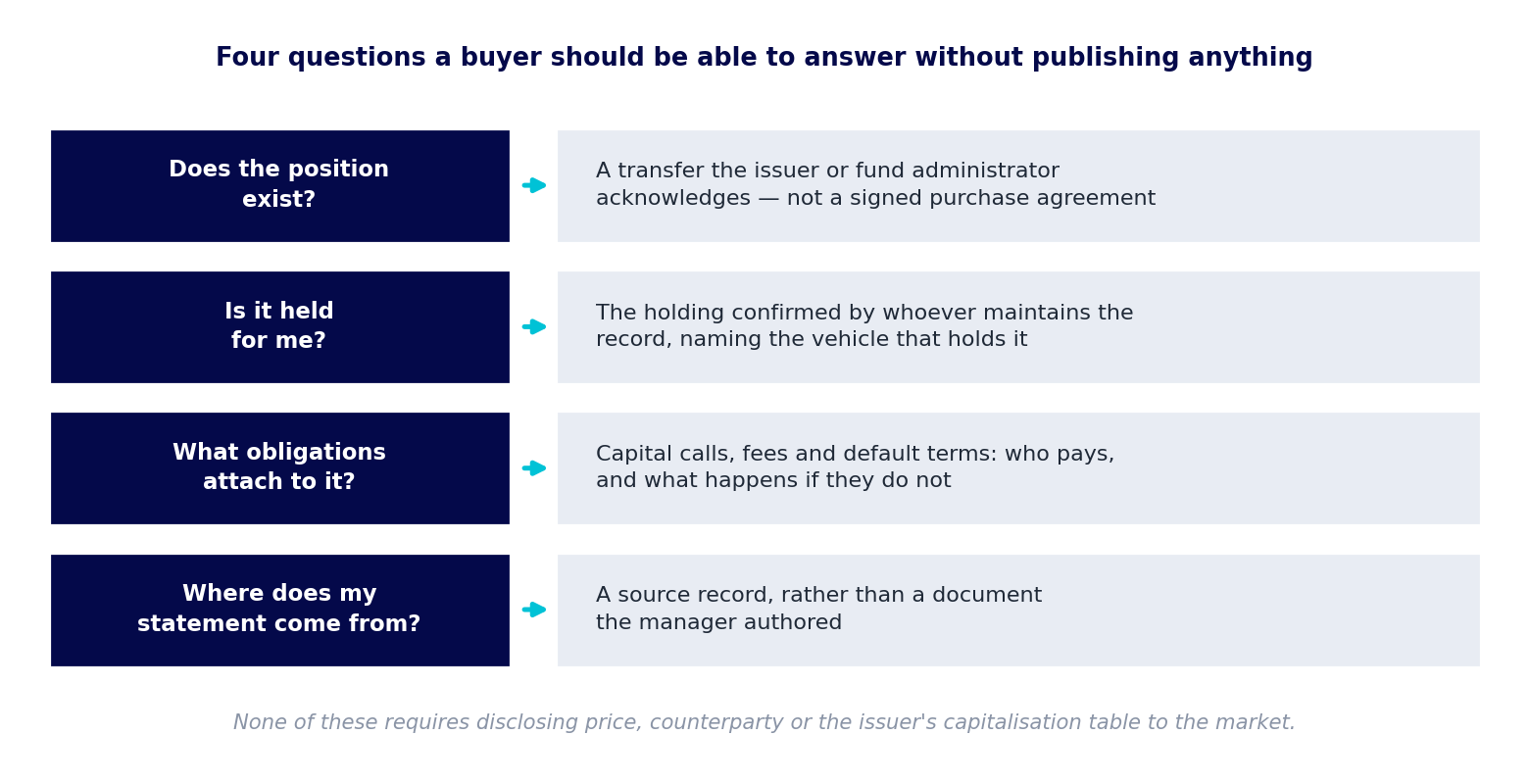
Source: Argent Bluebook. The failures described in the previous note each trace to one of these four questions going unanswered at the time capital moved.
Does the position exist? Not whether a purchase agreement was signed — one was signed in the case described in the previous note — but whether the party controlling the register or the fund's books has acknowledged the transfer. A signed agreement subject to a consent that was never given is a contract, not a holding.
Is it held for me? A vehicle that genuinely holds shares can still have sold them, pledged them, or allocated them to someone else. The question is whether the holding is confirmed by whoever maintains the record, and whether it is identified to the vehicle the investor subscribed to.
What obligations attach to it? Positions acquired through upstream funds carry capital calls, fees and default provisions. An investor who does not know those terms cannot know that a position can be lost for a sum trivial beside its value — US$46,020 against a US$3.1m position, in the case at hand.
Where does the statement come from? A valuation report assembled by the manager is an assertion. A report derived from a record the manager does not control is evidence. For three years, investors in that fund received statements referencing a real SpaceX tender price applied to a holding that did not exist. The number was accurate; the entitlement was not.
What infrastructure can and cannot do
It is worth being exact about this, because the enforcement action will produce a wave of claims that technology has solved private-market fraud. It has not, and the overclaiming is itself a risk indicator.
| Infrastructure can | Infrastructure cannot |
|---|---|
| Establish and evidence identity and beneficial ownership on both sides before a transaction proceeds | Grant an exemption from a transfer restriction, a right of first refusal or a consent requirement |
| Record whether a consent or acknowledgement has been obtained, and show when it has not | Compel an issuer or a fund to recognise a transfer it has declined |
| Keep an auditable trail of what was represented, by whom, and when | Substitute for the buyer's own diligence, valuation judgement or legal advice |
| Standardise documentation so that terms are comparable rather than bespoke | Make an illiquid asset liquid, or remove the risk that it loses value |
| Ensure funds move against a transfer that has been recognised, rather than before | Prevent a determined fraud — only make it harder to sustain undetected |
The last line is the important one. Nothing described here would have stopped a manager from attempting what the SEC alleges. What it would have changed is how long the attempt survived. A fund whose statements derive from a record the manager does not author cannot show three years of appreciation on a position that was refused in month two. The fraud is not made impossible; it is made brief, and brevity is most of what protects investors.
What this implies for how the market is built
- Verification before capital, not after. The point at which a buyer has leverage is before the wire. Once funds sit in a manager-controlled account, the investor's only remedy is litigation.
- Fewer layers, and each one disclosed. Depth is not inherently fraudulent, but an investor should know how many entities sit between them and the register, and who bears the obligations at each level.
- Obligations surfaced at the outset. Capital calls and default terms belong in the subscription decision, not in a document produced after a default.
- Reporting that is derived, not authored. The single most useful discipline in this market would be statements whose inputs the manager cannot edit.
- Re-verification, not a one-off check. Positions change hands, get pledged and get forfeited. A confirmation obtained at subscription says nothing about the position two years later — which is precisely the interval in which these cases unfolded.
The regulatory response is likely to be the wrong one
The predictable reaction to an enforcement action of this kind is to tighten access: raise thresholds, restrict who may buy pre-IPO exposure, treat the asset class as unsuitable. That response addresses the symptom. The investors in these funds were not harmed because they were permitted to buy private assets. They were harmed because they could not establish what they had bought, and no eligibility rule fixes that.
The more useful standard is narrower and testable: an investor in a private position should be able to establish, at the time of commitment and periodically afterwards, that the position exists, is held for them, and carries obligations they know about — without any of that being published. Every element of that standard is already met somewhere in finance. None of it requires an issuer to open its register, a buyer to disclose a strategy, or a seller to reveal a price.
Confidentiality was never the problem. Unverifiability was, and it is a choice about how the market is built rather than a property of private assets. The mechanics of a transaction that does complete were set out earlier in this series; the four questions above are simply the points in that sequence at which someone other than the seller has to be able to confirm what is happening.