
When listed holdings fall, private holdings can breach allocation limits without anything happening to the private companies themselves: the denominator effect.
The early-2026 software sell-off repriced public comparables and put pressure on private software marks (J.P. Morgan Asset Management).
Liquidity remains scarce: private equity distributions were about 14% of NAV in 2025, below 15% for a fourth straight year (Bain).
Crossover investors, meaning firms that hold both listed equities and late-stage private companies, sit on the fault line between public and private markets. When the two move out of step, portfolio construction becomes a practical problem rather than a theoretical one.
The mechanics: the denominator effect
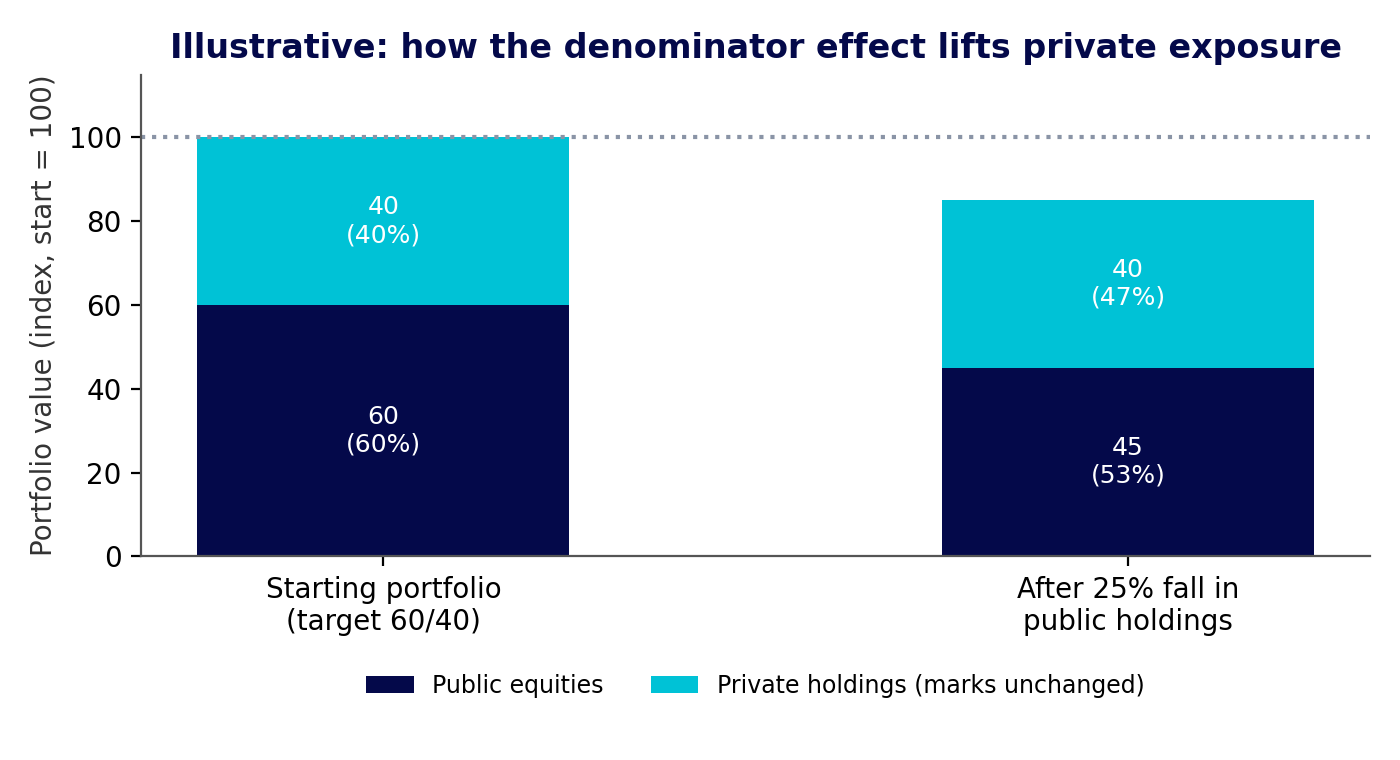
Most multi-asset mandates set target ranges for private exposure. Because private holdings are revalued infrequently, a sharp fall in listed holdings can push the private share above its target even though nothing has changed at the private companies. Take a simple case: a portfolio with 60% in listed equities and 40% in private companies sees its listed holdings fall by 25%. The listed sleeve drops from 60 to 45. With private marks unchanged, the total falls to 85, and private exposure rises from 40% to about 47% of the portfolio.
Figure 1: Illustrative denominator effect on a 60/40 public-private portfolio
Source: Argent Bluebook. Illustrative example only; not based on any specific fund or portfolio.
Managers then choose between tolerating the drift, slowing new private commitments, or reducing private exposure, which can mean selling positions in the secondary market. Jefferies reported that public and corporate pensions accounted for 48% of LP secondary volume in the first half of 2025, many of them overallocated to private equity and using the secondary market to rebalance [1]. The same logic applies, in more concentrated form, to crossover funds.
2026: the software reset
Early 2026 provided a real-world test. A wave of agentic-AI product launches led investors to reassess software business models, and listed software stocks sold off. J.P. Morgan Asset Management noted that the S&P BDC index, a bellwether for private credit, fell to a year-to-date low on 5 February as investors trimmed exposure to private credit funds with software exposure [2]. For software-heavy crossover portfolios, the result was a double squeeze: lower public marks on one side, and pressure to revisit the carrying values of private software holdings on the other.
A liquidity-constrained backdrop
Selling pressure is meeting a market in which cash was already scarce. Bain & Company's Global Private Equity Report 2026 found that distributions to limited partners held at about 14% of NAV in 2025, below 15% for a fourth consecutive year and an industry record, even though exit value rose 47% to US$717 billion [3]. Bain also reported that secondary transaction volume rose 41% year on year [3].
Pricing: structural sellers, different outcomes
When a seller trades for portfolio-construction reasons rather than a view on the company, the price reflects the time available and the depth of the buyer pool as much as fundamentals. Discounts are therefore far from uniform. Jefferies reported that venture and growth LP portfolios priced at an average of 78% of NAV in 2025, against 92% for buyout portfolios [4]. The gap reflects both asset risk and a thinner buyer base for venture exposure. At the single-company level the range is wider still: shares in companies with strong momentum can trade at or above the last primary round, while others clear at steep discounts.
Table 1: Liquidity and pricing indicators
| Indicator | 2025 | Source |
|---|---|---|
| PE distributions as % of NAV | ~14% (below 15% for 4th year) | Bain [3] |
| PE exit value | US$717bn (+47%) | Bain [3] |
| Average LP pricing, buyout portfolios | 92% of NAV | Jefferies [4] |
| Average LP pricing, venture and growth portfolios | 78% of NAV | Jefferies [4] |
Source: Bain & Company (23 Feb 2026); Jefferies (10 Feb 2026).
Precedent from the last cycle
The last correction offers a precedent. After the 2021–22 downturn, Tiger Global, one of the most active crossover investors, hired an adviser to sell stakes in private companies to return capital to its investors, according to the Financial Times as reported by Crunchbase News [5].
Adapting the model
The crossover model is itself evolving. In June 2026, Coatue was reported to be launching a long-biased crossover fund expected to allocate about 20% of its capital to private companies, while keeping the flexibility to sell positions and hold cash [6]. Designs of this kind, with explicit private allocation bands, cash buffers and pre-agreed liquidity tools, respond directly to the lessons of the last cycle.
What it means for the secondary market
For the secondary market, crossover rebalancing is both a source of supply and a test of infrastructure. Sellers need confidential price discovery, dependable transfer mechanics and timely settlement. Buyers need clear information about what they are acquiring. The denominator effect is not new, but in a year of sharp public-market repricing its practical consequences are easier to see.