
Defence-tech venture investment reached US$16.4bn in Q2 2026 alone, with trailing twelve-month investment of US$69.5bn (PitchBook).
Reported annual totals for 2025 range from US$8.8bn to US$49.1bn depending on whether dual-use companies are counted.
Secondary transfers in this sector carry export-control and foreign-ownership constraints that do not apply to ordinary enterprise software.
Defence technology has moved from an exclusion line in many investment policies to one of the most heavily funded categories in venture capital. The shift is measurable, but the numbers in circulation vary enormously, and the mechanics of trading these companies differ from anything in consumer or enterprise software.
The scale of the flows
PitchBook's Q2 2026 report records US$16.4 billion invested across 249 defence-technology deals in the quarter — the fourth largest quarter on record, 32.8% below a record first quarter — bringing trailing twelve-month investment to US$69.5 billion [1]. Autonomous systems took 42.1% of quarterly funding, led by Anduril's US$5 billion Series H at a US$61 billion post-money valuation [1]. Crunchbase, using a narrower definition, counted US$8.8 billion for the whole of 2025 [2].
Read the definition before the number
That gap is not a data error; it is a definitional one. Narrow counts include only companies selling primarily to defence customers. Broader counts include dual-use businesses — autonomy, space, cybersecurity, advanced manufacturing — whose revenue may be mostly commercial. Published 2025 totals ranged from about US$8.8 billion to US$49.1 billion across providers [2][3].
Figure 1: Reported 2025 defence-technology venture funding, by data provider
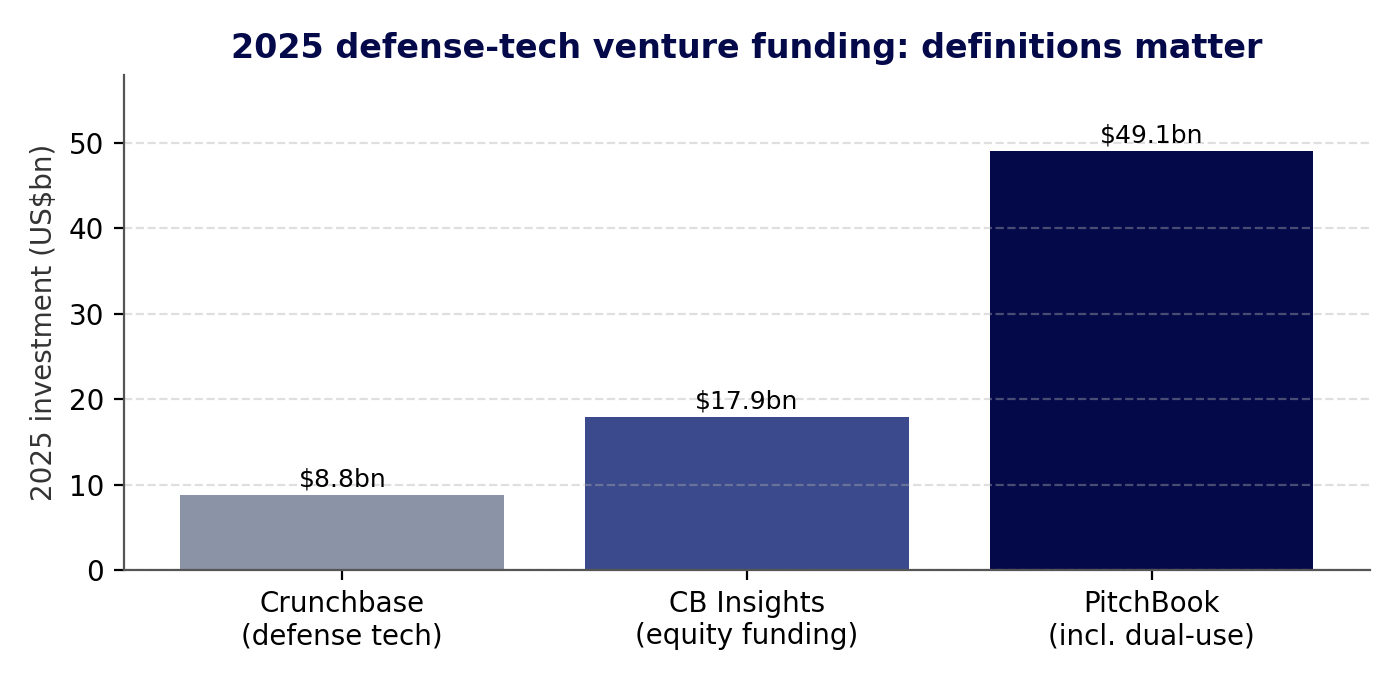
Source: Crunchbase (May 2026) [2]; CB Insights and PitchBook figures as reported by the Defence Innovation and Industrial Ecosystem review (Jan 2026) [3]. Definitions differ materially; figures are not directly comparable. Chart: Argent Bluebook.
For an investor, the consequence is practical: a claim that the sector “doubled” may describe a change in classification rather than a change in capital flows. The comparison worth making is like-for-like across a single provider.
Concentration at the top
Capital is highly concentrated. A small number of companies — Anduril at US$61 billion, Shield AI at US$12.7 billion, Saronic at US$9.25 billion — account for a large share of the sector's funding, while deal counts have risen far more slowly than dollars [4]. Valuations rest on expectations of sustained procurement: Anduril reported 2025 revenue of roughly US$2.2 billion, implying a multiple on trailing revenue that assumes substantial further growth [4]. Whether venture-backed entrants can convert prototype contracts into recurring programmes of record is the sector's central open question.
Why transfers are different here
Secondary transactions in defence and dual-use companies carry constraints that do not apply elsewhere. Exports of defence articles and technical data are regulated under the International Traffic in Arms Regulations, administered by the US State Department [5], and foreign investment in businesses involved in critical technologies can fall within CFIUS review [6]. Companies in the sector accordingly tend to scrutinise proposed transferees — including the ultimate beneficial owners behind any vehicle — more closely than a typical software company, and may decline transfers that create foreign-ownership issues. Investors should expect longer approval timelines and should take specialist legal advice before committing.
The portfolio argument, and its limits
The case made for the category is that defence spending follows multi-year government commitments rather than corporate IT budgets, offering revenue visibility uncorrelated with the enterprise software cycle. That is reasonable as far as it goes. The counter-considerations are equally concrete: revenue depends on political appropriations and procurement reform continuing; customer concentration is extreme; programme timelines slip; and exit routes are narrower, since foreign acquirers are frequently ruled out. A sector financed on the expectation of sustained government demand carries a distinctive form of policy risk, not an absence of risk.