
The idea that secondaries trade at a uniform discount is wrong in both directions: quality assets clear at or above NAV while tail-end portfolios trade far below.
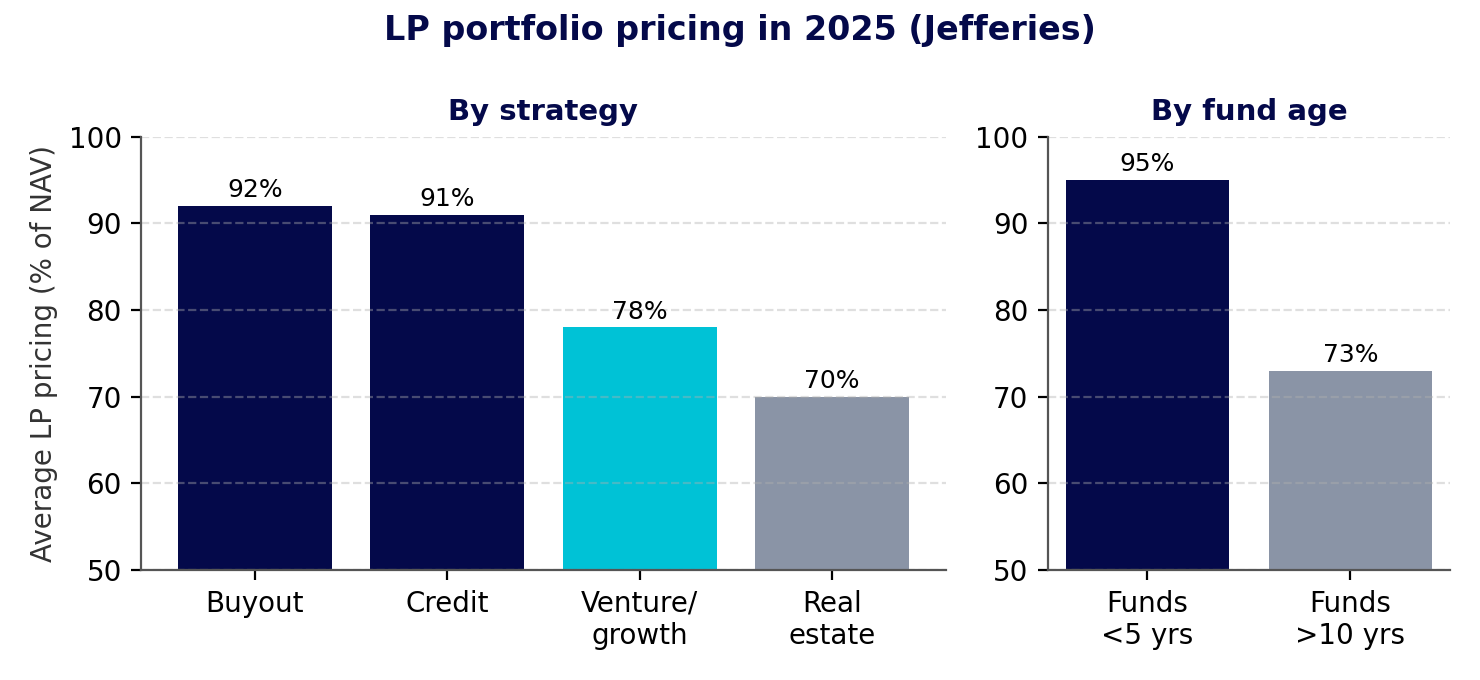
In 2025, buyout LP portfolios averaged 92% of NAV against 78% for venture and growth; funds under five years old averaged 95%, those over ten years 73% (Jefferies).
Single-company pricing moves with primary rounds: Forge reported a median trade at par in June 2026 and a 7% discount in July.
“Secondaries trade at a discount” is the most durable generalisation in private markets, and one of the least useful. The discount, where it exists, is a function of what is being sold, by whom, and under what time pressure. In 2026 the dispersion around the average is wider than the average itself.
Two axes of pricing
Jefferies' 2025 data show pricing varying along two dimensions at once. By strategy, buyout LP portfolios averaged 92% of NAV and credit 91%, while venture and growth portfolios averaged 78% and real estate 70%. By fund age, portfolios of funds less than five years old averaged 95% of NAV, while those over ten years old averaged 73% [1].
Figure 1: Average LP portfolio pricing in 2025, by strategy and fund age
Source: Jefferies Private Capital Advisory, 2025 Global Secondary Market Review (10 Feb 2026) [1]. Chart: Argent Bluebook.
The fund-age effect is often misread as a quality signal. An older fund holds assets that did not exit during a favourable window, but the discount also reflects a shorter remaining life, less visibility on residual value and a smaller pool of buyers willing to underwrite tail-end positions.
Where par pricing appears
At the other end, a substantial share of volume clears at or above NAV. Evercore reports that in the first half of 2026, 52% of single-asset continuation vehicle volume transacted at par and a further 14% above it, and that high-quality buyout LP portfolios cleared at around 90% of NAV [2]. Company-run tender offers show the same pattern in the single-company market: Carta's data show a median discount of 0% for tenders held at least a year after a primary round, though at least a quarter of such tenders in the first half of 2026 carried a double-digit discount [3].
Venture is where the split is sharpest
Venture secondaries have not followed the broader recovery. Evercore describes a K-shaped pricing environment in which leading franchises clear near par while weaker names trade at steep discounts, with venture volume flat at about US$5 billion in the first half of 2026 [2]. Two portfolios with the same reported NAV and vintage can therefore price 30 points apart, depending on whether a handful of assets within them are considered financeable.
Single-company pricing tracks primary rounds
For direct trades in a single company, the reference point is not NAV but the last primary round — and that reference moves. Forge reported that the median trade on its marketplace was at par in June 2026 and at a 7% discount in July [4]. Where a company has recently raised at a higher valuation, the secondary price adjusts toward it; where a round is stale, the discount widens to reflect uncertainty about what the current mark should be.
What a discount is actually compensating for
- Timing. A seller who must transact by quarter-end has less negotiating power than one who can wait.
- Information. The buyer underwrites with less information than the manager or issuer holds.
- Execution risk. Consent windows and rights of first refusal can delay or displace a trade.
- Duration. A position with no visible exit path is worth less than an identical position with one.
- NAV reliability. A discount to a stale or optimistic mark may be no discount at all.
The practical conclusion
Buying at a discount is not in itself a source of return, and paying par is not in itself imprudent. What matters is whether the price compensates for the specific risks in that transaction. Headline averages are useful for gauging market direction and almost useless for pricing a particular position — which is why the dispersion, rather than the mean, is the number worth watching.