
European venture investment was projected at about US$44bn for 2025: stable, but well below the 2021 peak (Atomico).
Capital is rotating. Deep tech's share of European VC rose to 36% (from 19% in 2021), while climate tech's fell to 18% (from 32% in 2023).
Mistral AI raised a €3bn Series D at a valuation above €21bn in September 2026, up from €11.7bn a year earlier.
“European tech independence” has become a political theme, but the picture in private markets is more measured than the slogan suggests. Atomico's State of European Tech 2025 describes an ecosystem worth close to US$4 trillion, about 15% of European GDP, but one in which venture investment has stabilised rather than surged, at a projected US$44 billion for 2025 [1][2].
Table 1: European tech at a glance
| Indicator | Value | Note |
|---|---|---|
| Ecosystem value (public and private) | ~US$4tn | Under US$1tn a decade earlier |
| Tech sector share of European GDP | ~15% | 4% in 2016 |
| Venture investment, 2025 (projected) | ~US$44bn | Roughly flat year on year |
| Survey respondents more optimistic than a year ago | 50% | Highest reading since 2021 |
| Founders who relocated their headquarters | 15% | 57% of those moved to the US |
Source: Atomico, State of European Tech 2025, as reported by Invest Europe (19 Nov 2025) and Sifted (18 Nov 2025) [1][2].
A rotation, not a boom
The most important shift is in where the capital goes. Deep tech, which spans AI, quantum, semiconductors, defence and space, accounted for 36% of European venture funding in 2025, up from 19% in 2021 [3]. Climate tech moved the other way. After taking 32% of capital invested in 2023, its share fell to 18% in 2025 as sentiment cooled [2]. Europe remains a significant climate-tech market by global standards, but the 2025 data do not support a “climate boom” narrative. For capital-intensive climate hardware, long development cycles and large funding needs also lengthen the road to liquidity, whether through primary or secondary markets.
Figure 1: Deep tech and climate tech as a share of European venture investment
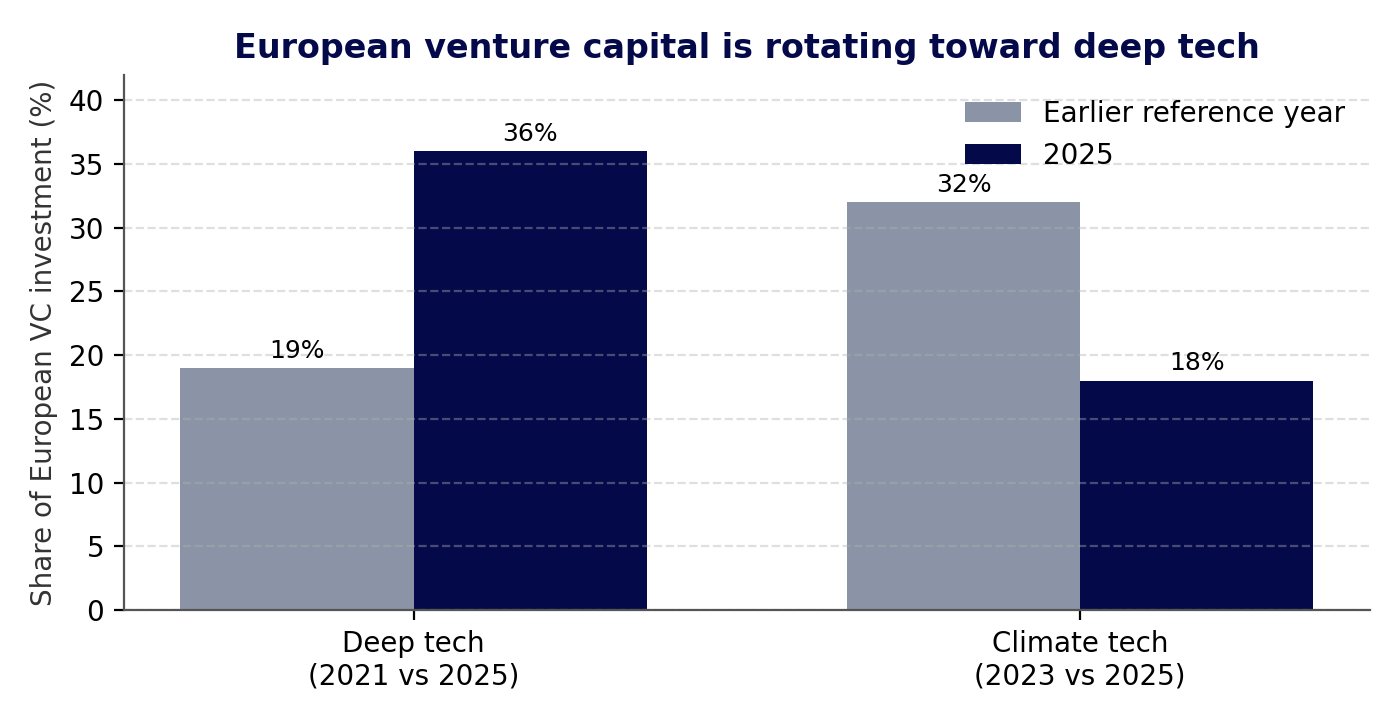
Source: Atomico, State of European Tech 2025, as reported by VivaTech (21 Nov 2025) and Sifted (18 Nov 2025) [2][3]. Chart: Argent Bluebook.
Sovereign AI: Mistral as the reference point
If Europe has a sovereign-AI flagship, it is Paris-based Mistral AI. The company raised a €1.7 billion Series C at an €11.7 billion post-money valuation in September 2025, led by the Dutch semiconductor-equipment maker ASML [4]. A year later, on 8 September 2026, the company announced a €3 billion Series D at a valuation of more than €21 billion [5]. An industrial champion as lead investor, rather than a purely financial one, shows how European “sovereign” technology is increasingly being financed.
The gap with the United States nonetheless remains wide. Atomico's analysis points to a substantial AI funding gap, with European AI companies raising about US$14 billion against US$146 billion in the US [6].
Secondary liquidity: early and thin
Claims that European sovereign-AI companies are already generating large secondary volumes should be treated with caution. Public data on direct secondary trading in European private companies is limited, and most of the European secondary activity that advisers measure relates to fund interests and continuation vehicles rather than single-company shares. What can be observed is rising demand for liquidity as holding periods lengthen, and a continuing pull toward the US: 15% of founders surveyed by Atomico had moved their headquarters abroad, and most of those chose the US [2].
Structural considerations for cross-border participants
European private companies are usually organised under national corporate forms, such as the French SAS or the German GmbH, each with its own rules on share transfers. Some forms involve formal requirements, such as notarisation, that add time to a transaction. Separately, the EU's framework for screening foreign direct investment allows member states to review investments in strategic sectors, including AI and semiconductors [7]. The EU AI Act, in force since August 2024, sets obligations for providers and deployers of AI systems [8]. It regulates products and uses, not shareholder registers, but it does shape the risk profile of the companies being traded.
Outlook
Europe's private champions are real, but the investment story rests on selective, strategic capital rather than a broad-based surge. For global allocators, the more useful question is not whether Europe has “decoupled” from Silicon Valley (the data suggest it has not), but where individual companies sit in their funding and liquidity cycle.
Table 2: Mistral AI funding reference points
| Date | Event | Valuation | Status |
|---|---|---|---|
| Sep 2025 | €1.7bn Series C, led by ASML | €11.7bn post-money | Announced by company |
| Sep 2026 | €3bn Series D | >€21bn | Announced by company |
Source: Mistral AI (9 Sep 2025) [4]; TechCrunch (8 Sep 2026) [5].