
2026 has largely answered the question. SpaceX listed on 12 June in the largest IPO on record, and Anthropic and OpenAI have both filed confidentially.
Private capital proved it can fund trillion-dollar ambitions, with Anthropic raising US$65bn at US$965bn, yet the largest companies are still choosing public markets.
Secondaries are settling into a role as a liquidity and price-discovery layer before and after listings, with 2026 volume projected at US$250–260bn (Evercore).
When this series began, a central question in private markets was whether the most valuable technology companies would ever need to list. By September 2026, the market has supplied an answer, or at least the first half of one.
Private capital reached unprecedented scale
The first half of 2026 showed what private capital can now do. OpenAI closed a US$122 billion round at an US$852 billion valuation in March [1]. In May, Anthropic raised US$65 billion at a US$965 billion post-money valuation, and said its run-rate revenue had crossed US$47 billion [2]. Bloomberg later reported that Anthropic's annualised revenue run rate topped US$65 billion by the end of July [3]. ByteDance, meanwhile, remains private: a proposed stake sale by General Atlantic early this year valued it at about US$550 billion, according to Reuters [4].
Figure 1: Reported valuation marks for selected technology companies
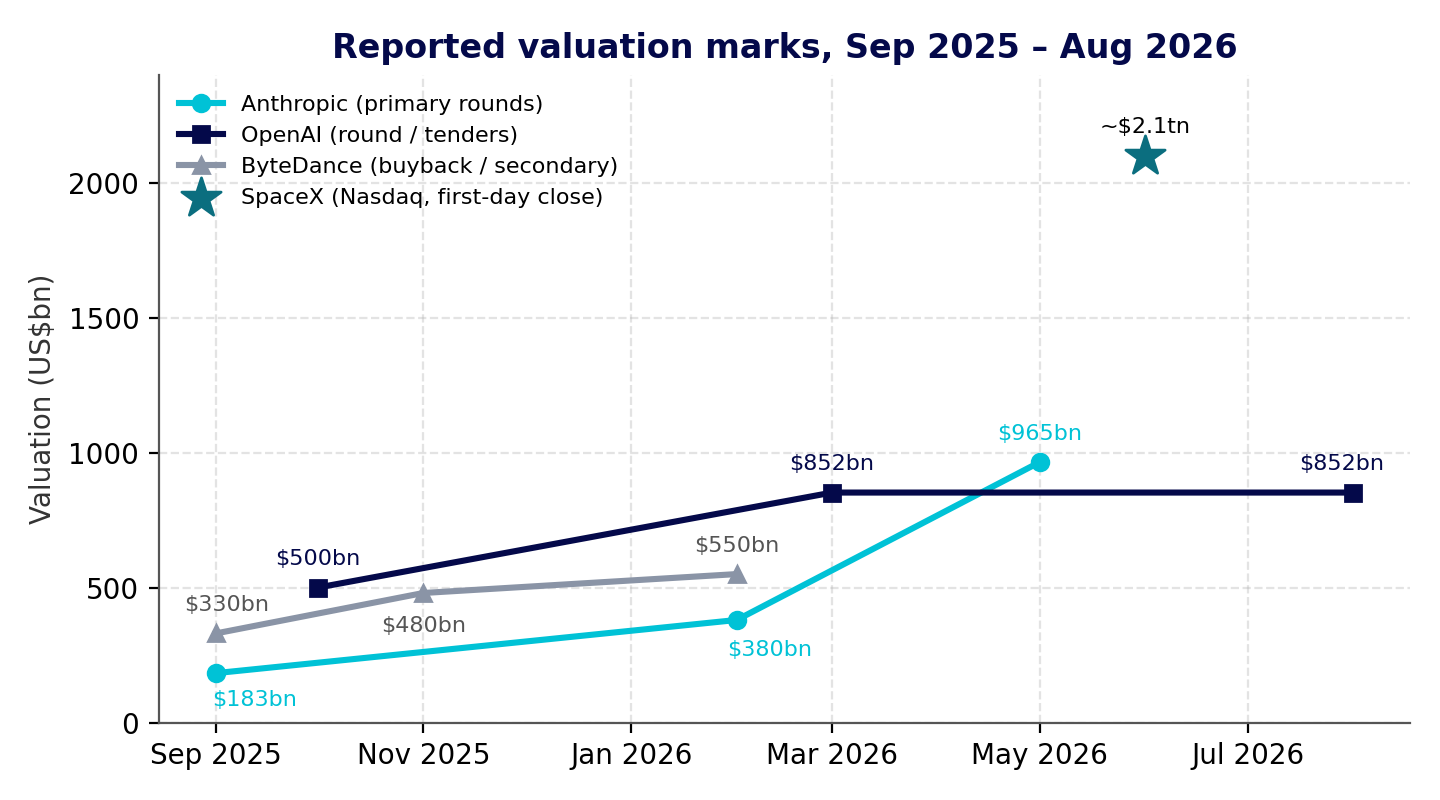
Source: Anthropic (Series F, 2 Sep 2025; Series H, 28 May 2026) [2][10]; Forge Global (Series G, Mar 2026) [11]; Dealroom News and Bloomberg (OpenAI tenders) [7][12]; CNBC (OpenAI March round) [1]; Reuters (ByteDance) [4]; CNBC (SpaceX first-day close, 12 Jun 2026) [5]. Marks are drawn from different transaction types and are not directly comparable. Chart: Argent Bluebook.
And yet the IPO window opened
Scale did not remove the pull of public markets. SpaceX, for years the most closely followed name in the secondary market, listed on Nasdaq on 12 June 2026. It raised about US$75 billion at US$135 per share in the largest IPO on record, and closed its first day up about 19% with a market value of roughly US$2.1 trillion [5][13]. Anthropic announced on 1 June that it had confidentially submitted a draft registration statement to the SEC [6]. OpenAI filed confidentially in June as well, and its chief financial officer told employees in August that the company “will be a public company in 2027,” or sooner if growth continues, according to CNBC [8].
The reasons are practical. Even at record size, private rounds cannot easily provide the combination of permanent capital, a liquid currency for acquisitions and broad-based liquidity for thousands of employees and early investors. OpenAI's CFO reportedly described the listing to staff as another fundraising milestone rather than a finish line [8].
What changes for the secondary market
The more useful question for 2027 is not whether mega-caps will list but what role secondaries play on either side of a listing.
- Before the IPO. Tender offers and structured secondary sales manage liquidity for employees and early investors; OpenAI's roughly US$7 billion buyback in August is one example [7]. Issuer control is also tightening. Anthropic's May notice declaring board-unapproved transfers void shows how closely companies scrutinise their registers as a listing approaches [9].
- Between rounds. Frequent, large primary rounds reset reference prices quickly. Forge reported that the median trade on its marketplace in July 2026 was at a 7% discount to the last primary round, compared with par in June [14]. Secondary prices move around primary marks rather than replacing them.
- Across the market. Dedicated secondary capital and evergreen vehicles continue to grow. Evercore projects 2026 volume of US$250–260 billion [15], and Jefferies sees a path toward US$300 billion within 12 to 24 months [16].
Consolidation and professionalisation
In our view, market infrastructure will keep professionalising. Issuers increasingly prefer to work with a small number of approved intermediaries, and compliance costs are rising. Both trends point toward further consolidation among trading venues and private-market data providers, with the larger platforms adding pricing references, data and institutional execution.
Table 1: The 2026 listing pipeline at a glance
| Company | Latest private mark | Listing status (as at 17 Sep 2026) |
|---|---|---|
| SpaceX | n/a (now listed) | Listed on Nasdaq, 12 Jun 2026; ~US$75bn raised at US$135/share [5] |
| Anthropic | US$965bn (Series H, May 2026) [2] | Confidential draft S-1 announced 1 Jun 2026 [6] |
| OpenAI | US$852bn (Mar 2026; Aug 2026 tender) [1][7] | Confidential filing Jun 2026; CFO signals 2027 [8] |
| ByteDance | ~US$550bn (proposed sale, Feb 2026) [4] | Private; no listing announced |
Source: as cited. Status reflects public reporting as at the publication date.
Our 2027 observations
These are observations about market structure, not investment views on any company.
- The idea that companies can stay private indefinitely has weakened for the very largest; for the next tier, companies valued in the tens of billions, longer private holding periods remain the norm.
- Issuer-sanctioned liquidity, meaning tenders and approved secondary programmes, is likely to grow faster than unsanctioned trading.
- The secondary market's role as a price-discovery and liquidity layer should keep expanding, alongside public markets rather than in place of them.