
Geopolitics is the top risk for family offices, cited by 64% (J.P. Morgan Private Bank, 2026).
Sovereign wealth funds rose from 12% to 21% of LP-led secondary seller volume in H1 2026 (Evercore).
Volume remains concentrated in North America; Asia-Pacific and the rest of the world account for just 2% of GP-led volume.
Cross-border capital is now a permanent feature of late-stage private technology. Sovereign investors sit on the capitalisation tables of the largest AI companies. Anthropic's US$65 billion Series H in May 2026, for example, was co-led by a group that included Singapore's GIC, and its significant investors included Temasek and Abu Dhabi's MGX [1]. At the same time, family offices in Asia and the Middle East are building direct private-market programmes. The channels connecting this capital to Silicon Valley matter more than ever, and they are growing more complex.
Geopolitics as the headline risk
J.P. Morgan Private Bank's 2026 Global Family Office Report found that geopolitics is now the top risk cited by family offices, named by 64% of respondents [2]. The report also found that while 65% of family offices intend to prioritise AI investments, many have yet to build exposure to the growth equity, venture capital and infrastructure segments where much of AI's value is being created privately [2].
Where the volume is
Evercore's H1 2026 Secondary Market Review shows how concentrated the market remains. By portfolio-company geography, North America accounted for 69% of GP-led volume, EMEA for 29%, and Asia-Pacific and the rest of the world for just 2% [3]. On the LP-led side, North American sellers accounted for 65% of volume and EMEA sellers for 31%, up from 24% [3]. Sovereign wealth funds rose from 12% to 21% of LP-led seller volume, which Evercore attributes to large, repeat sellers managing their portfolios actively [3]. Sovereign capital is therefore not only a buyer of private technology exposure but, increasingly, a seller in the secondary market.
Figure 1: Secondary transaction volume by geography, H1 2026
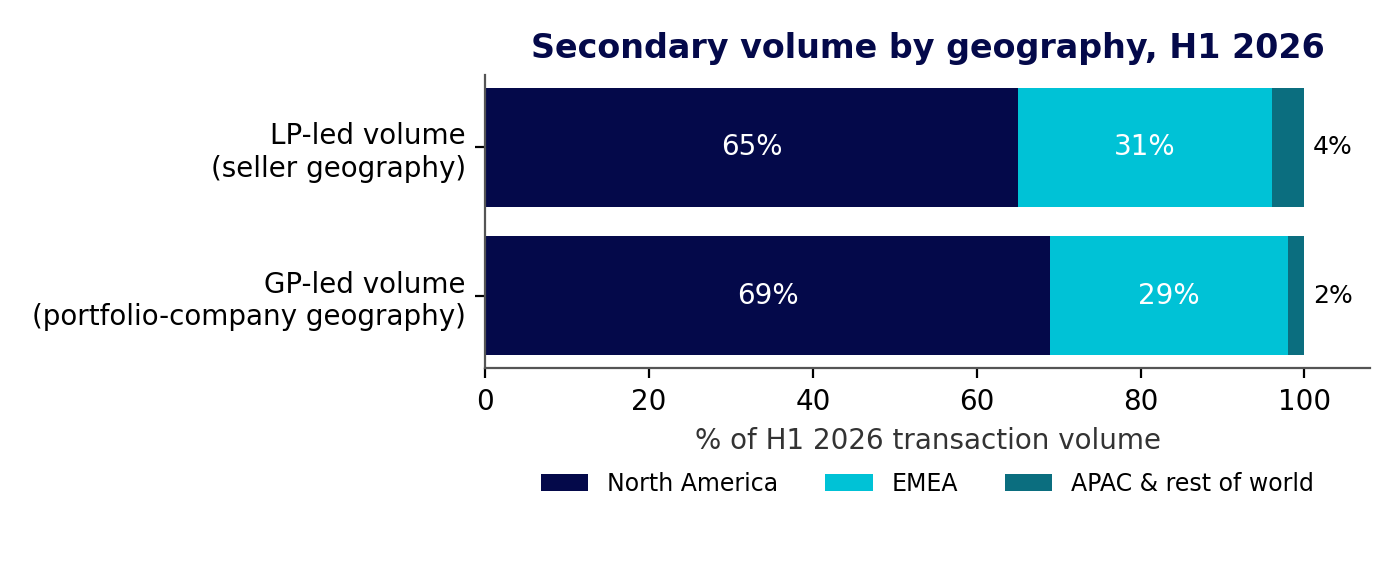
Source: Evercore Private Capital Advisory, H1 2026 Secondary Market Review (July 2026) [3]. Chart: Argent Bluebook.
The Gulf's weight in global sovereign capital adds to the significance of these flows. Jefferies notes that the six Gulf Cooperation Council states control roughly 40% of global sovereign wealth fund assets [4].
Regulatory friction runs in both directions
Cross-border trades face screening on the way in and on the way out. Inbound, the Committee on Foreign Investment in the United States (CFIUS) can review certain foreign investments in US businesses, including those involving critical technologies [5]. Outbound, the US Treasury's Outbound Investment Security Program, in force since 2 January 2025, prohibits or requires notification of certain investments by US persons in AI, semiconductor and quantum businesses connected to China, including Hong Kong and Macau [6][7]. For AI, the notification test includes systems trained using more than 10^23 computational operations [6].
The practical effect is that the same asset can raise very different questions depending on who is buying and from where. ByteDance illustrates the point. Its implied valuation has risen through a series of private transactions: a share buyback at more than US$330 billion in 2025, a secondary deal at US$480 billion in November 2025, and a proposed stake sale by General Atlantic in early 2026 that valued the company at about US$550 billion, according to Reuters [8]. Reuters also reported that HSG, formerly Sequoia Capital China, was raising a continuation fund to take over some of its ByteDance shares [8]. Each of these transactions involves different investor nationalities, company approval processes and regulatory analyses.
Table 1: Selected screening regimes relevant to cross-border private technology trades
| Regime | Direction | Scope (summary) |
|---|---|---|
| CFIUS (United States) | Inbound | Review of certain foreign investments in US businesses, including critical technologies |
| Outbound Investment Security Program (United States) | Outbound | Prohibits or requires notice of certain US-person investments in AI, semiconductors and quantum linked to China, Hong Kong and Macau; effective 2 Jan 2025 |
| EU FDI Screening Regulation | Inbound | Framework for member-state screening of foreign investment in strategic sectors |
Source: U.S. Department of the Treasury [5]; Greenberg Traurig (Dec 2024) [6]; Congressional Research Service (Mar 2026) [7]; EUR-Lex [9]. Summary only; not legal advice.
Issuer control
Issuers apply their own gatekeeping. Most late-stage companies require board approval for transfers, and some restrict the kinds of vehicles allowed to hold their shares. Anthropic's May 2026 notice, which declared unapproved transfers void and prohibited SPVs from acquiring its stock, applies regardless of the buyer's jurisdiction [10]. For offshore investors used to reaching US technology through layered vehicles, this is a material consideration.
The role of regulated intermediaries
In Hong Kong, shares of private companies incorporated outside Hong Kong generally fall within the definition of securities under the Securities and Futures Ordinance. Firms that deal in or advise on them therefore typically need SFC licences for Type 1 (dealing in securities) and/or Type 4 (advising on securities) regulated activity, subject to exemptions [11][12]. Licensing brings obligations covering client due diligence, suitability, the handling of client assets and conduct. This is one reason institutional investors increasingly prefer regulated intermediaries for cross-border private-share transactions.
Outlook
Capital will keep flowing across borders into private technology, but not without friction. The infrastructure that serves this market best will be the infrastructure that manages issuer approvals, investor eligibility and multi-jurisdictional rules in a single, auditable process, rather than implying that any of these constraints can be engineered away.