
GP-led transactions reached US$65bn in H1 2026, outpacing LP-led volume for the first half (Evercore).
Pricing splits sharply by structure: 52% of single-asset continuation vehicle volume traded at par and 14% above, against 22% at par for multi-asset vehicles.
Governance is the open issue: ILPA consulted on updated guidance in mid-2026, and about 30% of LPs still view continuation-vehicle assets as challenged.
A decade ago, moving an asset from one fund into another vehicle managed by the same sponsor was unusual enough to require explanation. It is now a standard exit route. The question has shifted from whether continuation vehicles are legitimate to whether individual transactions are priced and governed well.
Scale
Evercore reports that GP-led transactions accounted for about US$65 billion of the record US$121 billion of secondary volume in the first half of 2026, ahead of LP-led activity at US$56 billion [1]. Jefferies estimated GP-led volume of US$115 billion for 2025 as a whole [2]. McKinsey cites an estimate that continuation vehicles now represent roughly 14% of sponsor-backed exits [3]. The structure has become a mainstream component of the exit mix rather than a workaround for assets that cannot be sold.
Why sponsors use them
The rationale is straightforward when an asset is performing. Fund lives are finite; conviction is not. A continuation vehicle allows a sponsor to keep managing a business it knows while returning capital to investors who want it, and to raise new capital for a further phase of growth. Bain's 2026 data help explain the timing: with distributions to investors stuck at about 14% of net asset value for a fourth consecutive year, sponsors are under pressure to generate liquidity without selling into an unwilling market [4].
Pricing is not uniform
Evercore's first-half data show a clear distinction by structure. Among single-asset continuation vehicles, 52% of volume transacted at par and a further 14% above NAV, with 34% below. Among multi-asset vehicles, 71% of volume traded below NAV, 22% at par and 8% above [1].
Figure 1: Continuation-vehicle pricing relative to NAV, H1 2026
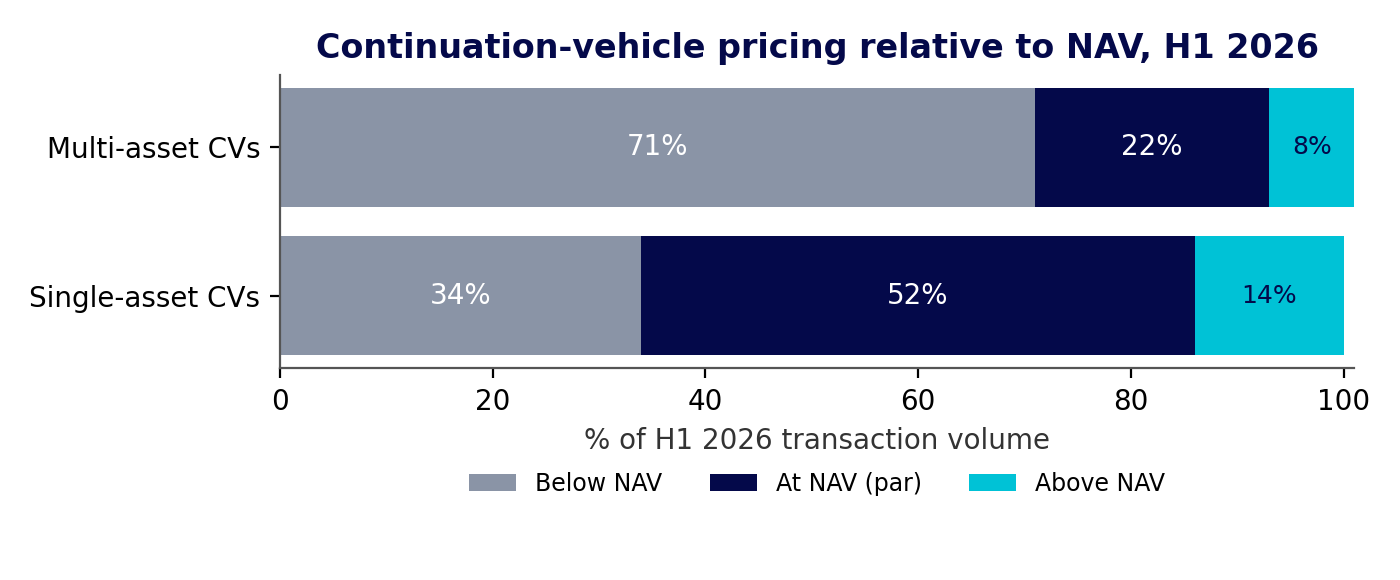
Source: Evercore Private Capital Advisory, H1 2026 Secondary Market Review (July 2026) [1]. Chart: Argent Bluebook.
The pattern is consistent with buyer behaviour elsewhere in the market: concentrated exposure to a single, well-understood asset attracts competition, while diversified pools of mixed quality do not.
The sell-or-roll decision
For an existing investor, a continuation vehicle forces a choice: sell at the price established in the process, or roll into the new vehicle on its terms. The two options are not symmetrical. Selling crystallises a valuation set in a process the sponsor initiated. Rolling means accepting a new fee structure, a new holding period and, frequently, new carried-interest terms, in a vehicle whose principal asset the investor already owned.
This is where governance matters. ILPA's guidance has long recommended that existing investors receive information comparable to that given to the acquiring buyer, and at least 30 calendar days (or 20 business days) to make the election [5]. ILPA released draft updated guidance for continuation vehicles in June 2026, addressing valuation, conflicts and the terms on which investors roll [6]. The persistence of the debate is reflected in McKinsey's finding that about 30% of limited partners view assets placed into these vehicles as distressed or challenged [3].
What a credible process looks like
- A price tested by competitive bidding from unaffiliated buyers rather than set by reference to the sponsor's own marks.
- Timely, comparable disclosure to existing investors, including the assumptions behind the valuation.
- Clear treatment of conflicts, including any crystallisation of carried interest and the sponsor's own commitment to the new vehicle.
- A default option for investors who do not respond that does not disadvantage them.
Outlook
Continuation vehicles are likely to remain a permanent feature of the exit landscape, particularly while distributions stay low and IPO windows open selectively. Their reputation over the next cycle will rest on whether the assets that entered them at par continue to perform, and on whether the governance standards now under consultation become common practice rather than best-in-class exceptions.