
H1 2026 secondary volume set a record: US$121bn according to Evercore and US$118bn according to Jefferies.
53% of secondary buyers now run an evergreen vehicle, and semi-liquid evergreen funds hold about US$500bn of industry AUM (Evercore).
Evergreen capital is growing but remains supplemental; many managers are capping subscriptions to match the opportunity set.
Open-ended, or “evergreen,” private-market funds have moved from product experiment to a meaningful source of demand in the secondary market. Their growth has coincided with a record run in secondary volume, and the two trends are linked.
A record first half
Evercore reports that global secondary volume reached about US$121 billion in H1 2026, up roughly 19% year on year, with GP-led transactions (US$65 billion) ahead of LP-led transactions (US$56 billion) [1]. Jefferies, using its own methodology, puts first-half volume at a record US$118 billion, up 15% [2]. Both follow a record 2025, in which volume reached US$226 billion according to Evercore and US$240 billion according to Jefferies [1][3]. On Evercore's figures, annual volume has more than doubled since 2022.
Figure 1: Global secondary transaction volume, LP-led and GP-led (US$bn)
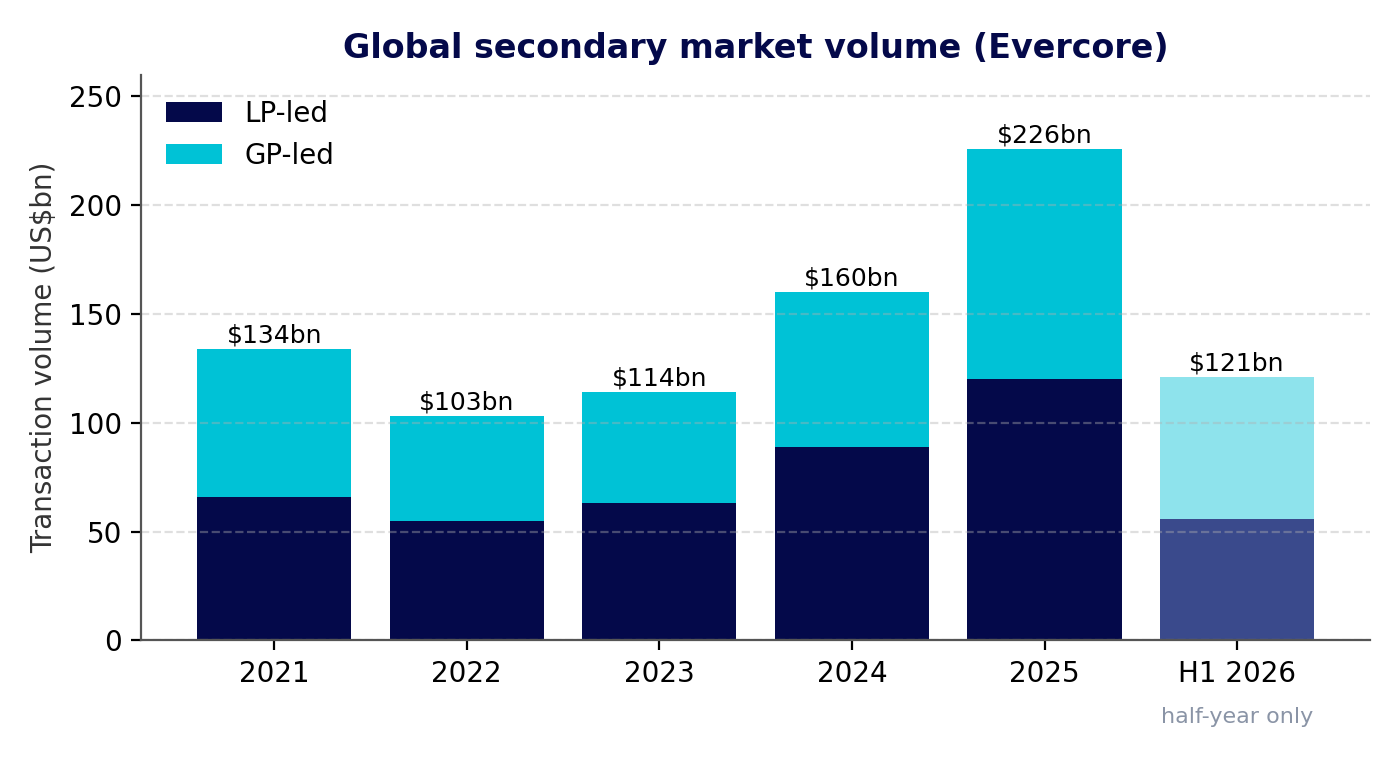
Source: Evercore Private Capital Advisory, H1 2026 Secondary Market Review (July 2026) [1]. H1 2026 is a half-year figure and is not comparable with full years. Chart: Argent Bluebook.
Evergreen capital: from niche to infrastructure
Evercore's survey of more than 100 active secondary buyers found that 53% now operate an evergreen vehicle [1]. Semi-liquid evergreen vehicles account for about US$500 billion of industry AUM, including more than US$130 billion managed by secondary firms, about 45% of which is allocated to secondary investments [1]. Jefferies estimates that evergreen vehicles supplied around US$113 billion of capital inflows in 2025, with roughly 41% allocated to secondaries [3].
Table 1: Evergreen capital in the secondary market
| Indicator | Value | Source |
|---|---|---|
| Share of secondary buyers operating an evergreen vehicle | 53% | Evercore, H1 2026 [1] |
| Semi-liquid evergreen AUM, industry-wide | ~US$500bn | Evercore [1] |
| Evergreen AUM managed by secondary firms | >US$130bn (~45% in secondaries) | Evercore [1] |
| Expected inflows to those vehicles, next 12 months | ~US$25bn (~US$11bn to secondaries) | Evercore [1] |
| Evergreen capital inflows, 2025 | ~US$113bn (~41% to secondaries) | Jefferies [3] |
Source: Evercore (July 2026); Jefferies (10 Feb 2026).
Why secondaries suit the structure
Three features make secondaries a natural fit for open-ended vehicles:
- Earlier cash flows. Secondary interests are usually bought later in a fund's or company's life, which can shorten the wait for distributions and soften the “J-curve” of early negative returns associated with new primary commitments.
- Faster deployment. Capital is put to work at the point of purchase rather than drawn down over several years, which matters for a vehicle that takes in subscriptions continuously.
- Diversification. A single portfolio purchase can provide exposure across managers, vintages and sectors.
Limits and trade-offs
The structure has real constraints. Evercore notes that evergreen capital remains supplemental: these vehicles typically invest alongside flagship closed-end funds and finance only a minority of the purchase price. Many managers are also capping subscriptions to match the available opportunity set, partly because of concerns about liquidity and drawdowns [1]. Evergreen funds offer periodic rather than daily liquidity, redemptions are generally subject to limits, and portfolios of illiquid assets are valued at periodic NAVs that may lag market conditions. Buying at a discount to NAV does not guarantee a gain either: the discount reflects the buyer's view of risk, timing and the reliability of the reference NAV.
Pricing supports the flow, with exceptions
Pricing has been firm. Evercore reports that high-quality buyout interests cleared at around 90% of NAV in H1 2026, and that 52% of single-asset continuation vehicle volume traded at par, with a further 14% above NAV [1]. Venture is the exception. Venture secondary volume was flat at about US$5 billion in H1 2026, and Evercore describes a K-shaped pricing environment in which top franchises clear near par while weaker names trade at steep discounts [1].
Outlook
Evercore projects full-year 2026 volume of US$250–260 billion based on typical second-half seasonality, while cautioning that historical trends do not predict future results [1]. Jefferies sees a path for annual volume to approach US$300 billion over the next 12 to 24 months [3]. If those projections hold, evergreen vehicles are likely to remain a steady, if supplementary, source of demand, particularly for diversified portfolios and high-quality continuation vehicles.