
The October 2025 recapitalisation created OpenAI Group PBC, with the OpenAI Foundation holding 26%, Microsoft about 27% and employees and investors 47%.
Liquidity has come through company-run transactions: US$6.6bn at a US$500bn valuation in October 2025 and about US$7bn at US$852bn in August 2026.
The company has filed confidentially for a listing, with its CFO pointing to 2027.
OpenAI is the most frequently discussed private company in the world and one of the least conventional. Its governance, its ownership and the routes by which its shareholders obtain liquidity all differ from the late-stage norm, and each affects how the equity should be understood.
What the recapitalisation changed
On 28 October 2025, OpenAI completed a recapitalisation. The non-profit became the OpenAI Foundation and retains control of the business; the for-profit arm became OpenAI Group PBC, a public benefit corporation. At closing, the Foundation held about 26% of the company — an equity stake then valued at roughly US$130 billion — Microsoft about 27% on an as-converted diluted basis, worth around US$135 billion, and current and former employees and other investors the remaining 47% [1][2]. The transaction removed the previous capped-profit structure, and Microsoft's access to OpenAI technology was extended to 2032 [3].
Figure 1: OpenAI Group PBC ownership as disclosed at the recapitalisation
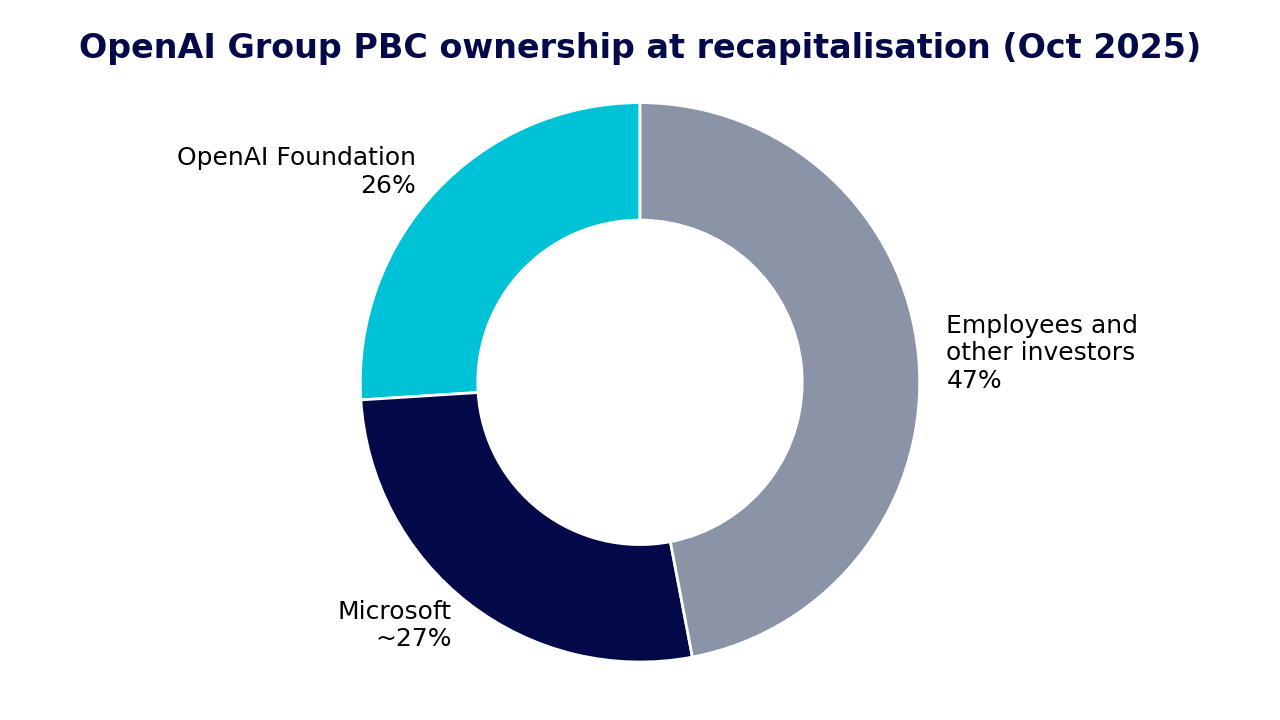
Source: CNBC (28 Oct 2025) [1]; OpenAI, “Our Structure” [2]. As-converted diluted basis at closing; subsequent financings are not reflected. Chart: Argent Bluebook.
Two features matter for any investor looking at the equity. Control does not follow economics: the Foundation's governance rights are separate from its stake, so a larger economic holder does not control the board. And as a public benefit corporation, the company is required to advance its stated mission alongside commercial objectives [2].
Liquidity is company-organised
Shareholder liquidity has come through transactions the company runs. In October 2025, alongside the restructuring, employees sold about US$6.6 billion of stock at a US$500 billion valuation [4]. In March 2026, OpenAI closed a US$122 billion primary round at an US$852 billion post-money valuation [5]. In August 2026 it completed a roughly US$7 billion buyback of employee shares at that same US$852 billion valuation — unchanged from the March round — funding the purchase itself rather than bringing in new outside buyers [6][7].
Table 1: OpenAI liquidity and valuation events
| Date | Event | Valuation |
|---|---|---|
| Oct 2025 | Recapitalisation; employee share sale of ~US$6.6bn | US$500bn [1][4] |
| Mar 2026 | Primary round of US$122bn | US$852bn post-money [5] |
| Jun 2026 | Confidential filing for a public listing | n/a [8] |
| Aug 2026 | Employee share buyback of ~US$7bn | US$852bn, unchanged [6][7] |
Source: as cited.
The flat valuation between March and August is itself informative. A company-run buyback prices at a level the board sets, usually by reference to the most recent primary round; it is not evidence that an open market would clear at the same level, in either direction.
Growth and the listing question
OpenAI's annualised revenue run rate reached about US$40 billion by August 2026, roughly double the US$20 billion reported at the end of 2025 [9]. The company filed confidentially for a listing in June 2026, and its chief financial officer told employees in August that OpenAI will be a public company in 2027, or sooner if growth continues [8].
Why the structure matters to buyers
Anyone evaluating exposure to OpenAI should be clear about three things. First, transfers require company approval: OpenAI stated publicly in July 2025 that tokenised products marketed as exposure to its equity were not its equity and that it had approved no transfer [10]. Second, the instrument matters — an interest in a vehicle that holds shares is not the same as shares, and carries its own fees and terms. Third, control sits with the Foundation, so ordinary expectations about shareholder influence do not apply.
The broader lesson is that structure is not a footnote to valuation. For a company of this size, the governance arrangements determine who decides on liquidity, on timing and on who is permitted to own the equity at all.