
Listed US equities settle one business day after trade. A private-share transfer commonly takes 30 to 90 days, and the delay is contractual rather than technological.
Rights of first refusal, investor cascades and board consent run sequentially, and each can reset the clock.
Market infrastructure is moving: the SEC granted DTC no-action relief for tokenised assets in December 2025, and DTCC has named private-market settlement a 2026 priority.
Public equity settlement in the United States has run on a T+1 cycle since May 2024, following an SEC rule change designed to reduce counterparty risk [1]. A transfer of shares in a private company works nothing like that. Between an agreed price and a completed transfer sit a series of contractual rights held by the company and its investors, and those rights, not the plumbing, set the timetable.
Where the time goes
A typical sequence begins when the seller delivers a transfer notice setting out the buyer, the number of shares and the price. The company then has a defined window — commonly 30 days — to exercise, waive or let lapse its right of first refusal [2]. Where investors hold a secondary refusal right, a further window follows. Board consent, joinders to existing shareholder agreements and funding complete the process. Practitioners routinely describe an end-to-end timeline of 30 to 90 days, and longer where windows run sequentially [3].
Figure 1: Illustrative timeline for a private-share transfer
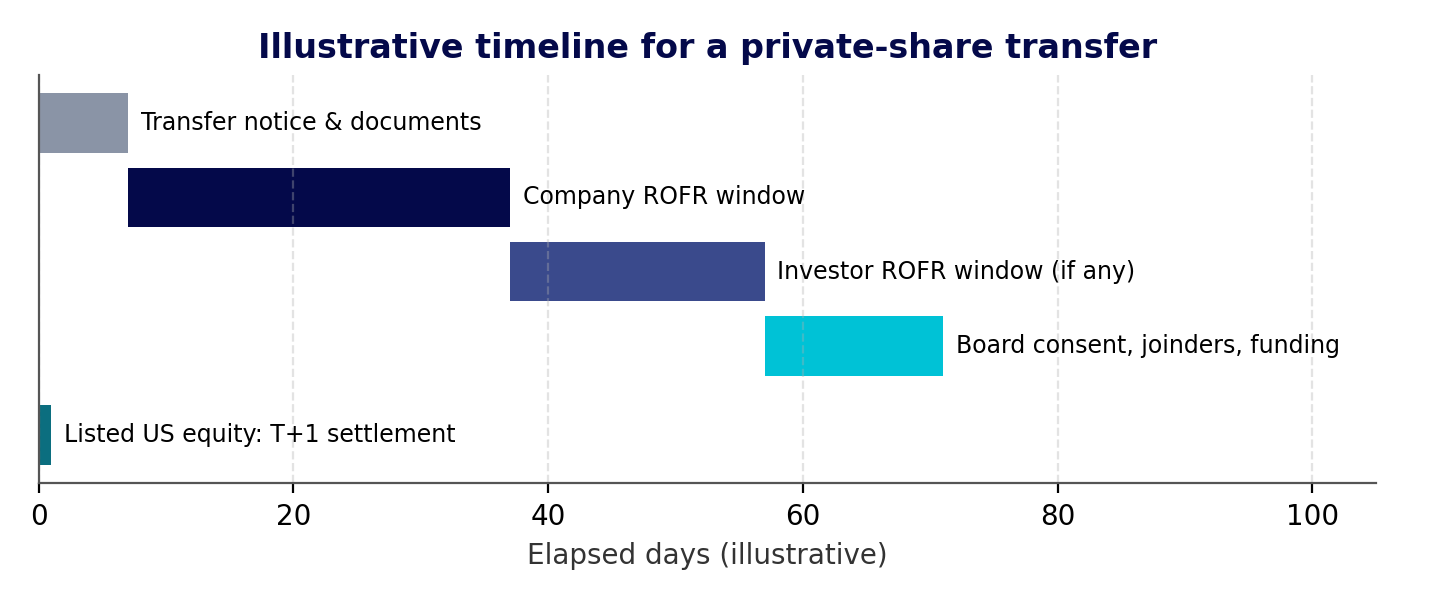
Source: Argent Bluebook, based on typical ROFR windows described by MicroVentures (2025) [2] and Primum Law (2026) [3]. Illustrative only; terms vary by company and are set by each company's constitutional documents.
Why the delay is expensive
Time is not a neutral cost. Between notice and close, the reference price can move, buyers can withdraw, and the transaction can be displaced if the company or its investors exercise their rights. That risk is priced. It is one reason single-company secondary trades frequently clear at a discount to the last primary round even when sentiment toward the company is positive.
What can and cannot be automated
Some of the delay is genuinely operational: chasing signatures across time zones, reconciling capitalisation records, and confirming that the correct entity is transferring the correct class of shares. Structured workflows, electronic execution and direct integration with cap-table systems remove much of that friction, and are where most infrastructure investment has gone.
The rest is not operational at all. A company's 30-day refusal window is a contractual right granted to it and its investors; software can make the notice arrive faster and the record update cleanly, but it cannot shorten a right that exists to give the company time to decide. Claims of near-instant settlement in private markets should therefore be treated with care: either the underlying rights have been waived in advance, as happens in company-sponsored tender offers, or what is settling is not a share transfer but a contractual interest in one.
Where the market infrastructure is heading
Institutional plumbing is nonetheless moving. In December 2025 the SEC staff granted The Depository Trust Company no-action relief allowing it to offer a tokenisation service for certain assets it already holds in custody, for a three-year period [4][5]. DTCC has separately said that, as capital formation shifts toward private assets, its first focus in this area will be settlement solutions [6]. Both developments concern infrastructure rather than the contractual rights described above, and neither removes the need for issuer approval.
The realistic ambition
The achievable goal is not public-market settlement speed. It is a predictable, auditable process in which every party knows which consents are outstanding, the cap-table record updates when the transfer completes, and funds move only against a transfer the issuer recognises. Predictability, rather than speed, is what reduces the discount attached to execution risk.