
SpaceX ran semi-annual tender offers for years, lifting its valuation from US$180bn in December 2023 to US$800bn in December 2025.
It listed on Nasdaq on 12 June 2026 in the largest IPO on record, closing its first day at about US$2.1tn.
The sequence shows what private liquidity can and cannot do: it retains employees and sets a price, but it does not fund capital expenditure at this scale.
For most of the last decade SpaceX was the reference case for staying private. It ran a disciplined internal liquidity programme, raised private capital at rising valuations, and avoided the disclosure and short-term scrutiny of public markets. In June 2026 it listed anyway. Both halves of that story are instructive.
The private-liquidity machine
SpaceX conducted tender offers roughly twice a year, allowing employees and early investors to sell to the company and to approved buyers [1]. The resulting series of valuations is unusually well documented for a private company: about US$180 billion in December 2023, US$210 billion at US$112 a share in June 2024, about US$350 billion at US$185 in December 2024, US$400 billion at US$212 in July 2025, and US$800 billion at US$421 in December 2025 [1][2][3]. In the December 2025 round, the company and its investors agreed to purchase up to US$2.56 billion of stock from eligible holders [3].
Figure 1: SpaceX valuation marks, from tender offers to listing
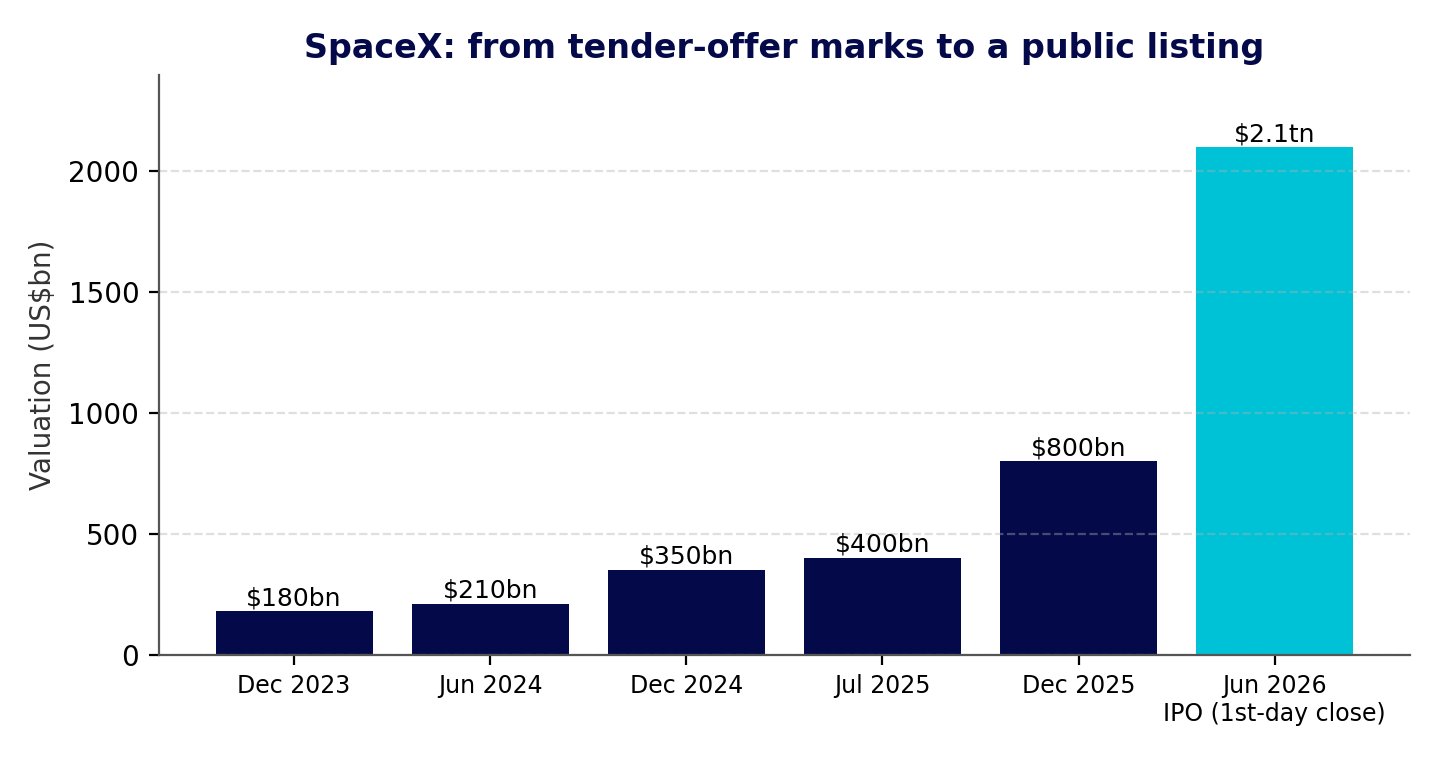
Source: Bloomberg via Gulf News (Jun 2024) [1]; Bloomberg (Dec 2024) [2]; CNBC and Fortune (Dec 2025) [3][4]; CNBC (first-day close, 12 Jun 2026) [5]. Tender-offer marks and a public market price are set by different processes. Chart: Argent Bluebook.
This is what a programmatic internal market looks like: predictable timing, a company-set price anchored to its own fair-market valuation process, and controlled access for buyers. It removed the main employee-retention argument for going public.
Why it listed anyway
The reason is capital intensity. SpaceX reported 2025 revenue of about US$18.7 billion, but also a substantial net loss, with first-quarter 2026 capital expenditure of roughly US$10.1 billion against US$4.1 billion a year earlier as it funded Starship, Starlink expansion and orbital data-centre ambitions [5]. Recurring tender offers transfer existing shares between holders; they raise nothing for the company. At that rate of investment, permanent capital and an acquisition currency matter, and the company had also absorbed xAI earlier in 2026 [6].
The listing on 12 June 2026 raised about US$75 billion at US$135 a share, the largest IPO on record, and the stock closed its first day about 19% higher, giving a market value of roughly US$2.1 trillion [5][7]. Alphabet was reported to hold a stake of close to 5% [5].
The price of a public price
The transition also imported public-market disagreement. Analysts publishing at the listing ranged from valuations far below the offer price to buy recommendations, a spread that reflects genuine uncertainty about Starlink's terminal growth rather than analytical failure [5]. A private tender price is a single number chosen by a company; a public price is the outcome of continuous argument. Companies moving between the two should expect volatility that has nothing to do with operational performance.
What this means for capital-intensive private companies
- Liquidity programmes buy time, not capital. They address retention and shareholder pressure; they do not fund factories, launch vehicles or data centres.
- A private mark is not a market clearing price. SpaceX's own marks rose steeply, but only the listing tested them against unrestricted demand.
- Transfer control matters throughout. SpaceX historically approved few outside transfers, which is why the tender programme, rather than open trading, defined its secondary market.
- The exit changes the investor base. Post-listing, ownership passes to investors with different horizons and disclosure expectations.
The broader read
Other capital-intensive sectors — nuclear, energy infrastructure, advanced manufacturing — are often told to follow the SpaceX model of staying private. The full sequence suggests a more careful lesson: a well-run internal market can sustain a company through a long private phase, but when capital requirements outgrow what private rounds can supply, the public market remains the destination. SpaceX did not disprove the IPO; it deferred it, and then used it.