
On 30 September the SEC charged an adviser and its chief executive over five alleged schemes across funds that raised about US$18.5m from nearly 100 investors for pre-IPO positions in SpaceX, OpenAI and others.
The defining failure was not the vehicle. In one fund the upstream transfer was refused outright, yet investors were told the deal had closed and were sent statements marked to a SpaceX tender price for three years.
Press reporting on SpaceX vehicles before the June listing describes the same pattern at scale: holders discovering only at the IPO that their position had been sold years earlier.
Private-market fraud has a recognisable shape. It is rarely a fake company or a forged certificate. It is an investor who paid for a position, received statements showing it appreciating, and discovered at the moment of liquidity that the position was never acquired, had been sold, or had been forfeited. The complaint the Securities and Exchange Commission filed on 30 September sets out that shape with unusual clarity, and it repays reading closely rather than filing away as another SPV story.
What the SEC alleges
The Commission charged Meyer Global Management LLC and its chief executive, Owen E. H. Meyer, with defrauding investors and the funds they advised [1]. From 2019 to 2024 the firm raised at least US$18.5m from nearly 100 investors across roughly 16 affiliated funds, each formed to acquire a single pre-IPO company — among them SpaceX, OpenAI, Neuralink and Relativity Space. The complaint identifies five schemes from December 2021 onward, alleging misappropriation of at least US$1.27m of client capital, assurances that money was safe when it had been spent, and distributions withheld unless investors signed releases accepting less than they were owed [2].
Those are serious allegations about one adviser's conduct. The structural lesson sits underneath them.
The moment the chain broke
One fund makes the point precisely. In early 2021 the fund raised about US$1.1m from thirteen investors to acquire an interest in another fund that held SpaceX shares, and paid US$1,035,000 to the seller. The transfer required the upstream fund's approval. On 2 April 2021 a representative of that fund wrote back in plain terms: they were unable to arrange a transfer. The acquisition did not happen [2].
Nearly three months later, on 29 June 2021, investors received an email headed “Starship VI – Closed!”. Through 2022 and into 2023 they received statements showing the holding appreciating, one of them referencing a SpaceX tender at US$770 per share. Meanwhile US$600,000 of their capital had been returned by the seller into an account the manager controlled, and by January 2023 it had been spent [2]. Investors were still being told their money had appreciated as late as September 2024.
Figure 1: One fund, two accounts of the same facts
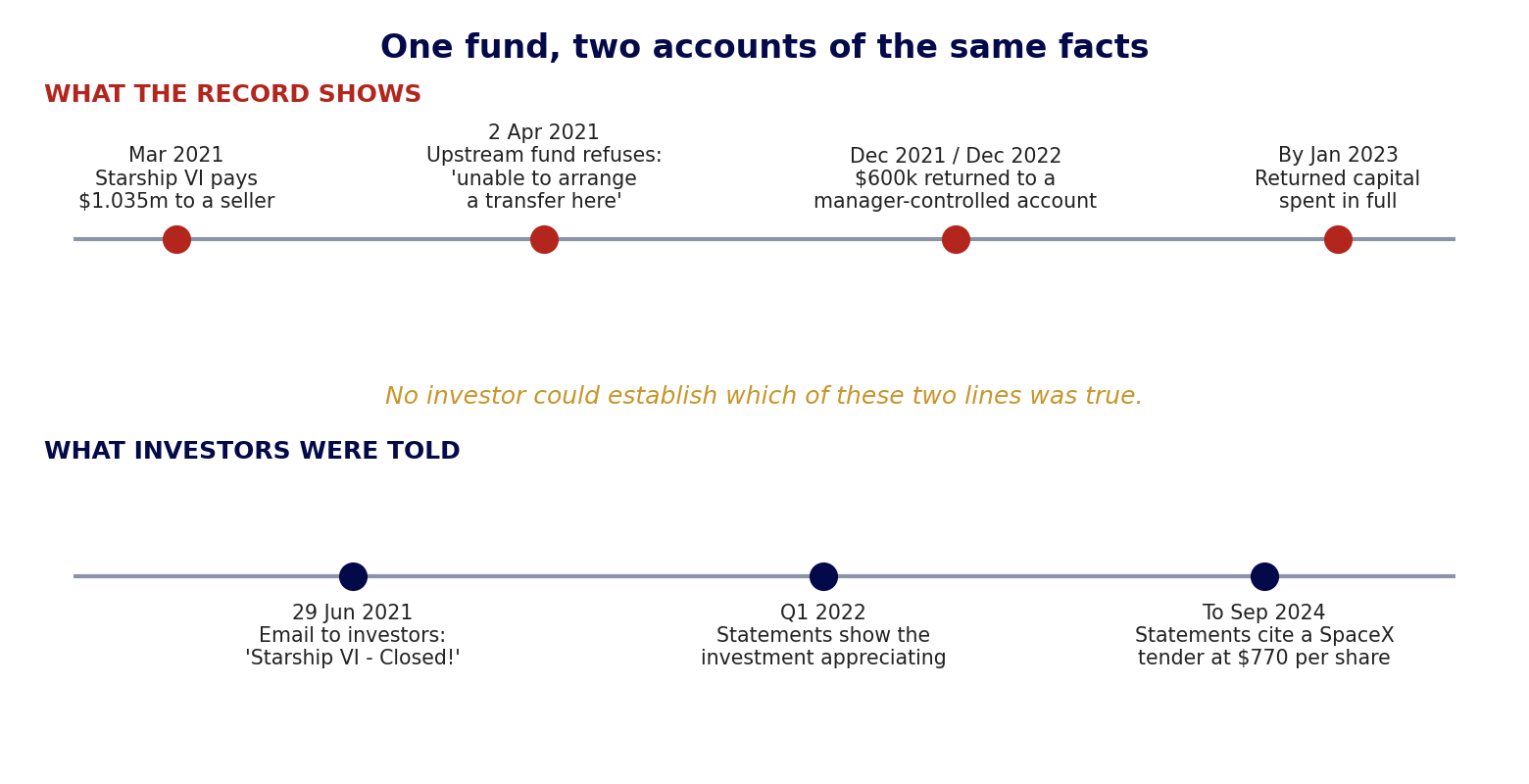
Source: SEC v. Meyer Global Management LLC and Owen E. H. Meyer, complaint filed in the Southern District of New York, 30 September 2026 [2]. Allegations; the defendants have not responded to the complaint at the time of writing. Chart: Argent Bluebook.
Set that sequence against the one described in the previous edition of this series, which followed a transaction from marketing through consents to a register update. Here there was a willing buyer, a willing seller, a signed agreement and money that moved. What was missing was a single verifiable fact: whether the entity that controlled the transfer had actually recognised it. That fact existed. It sat in an email that investors never saw, and nothing in the arrangement gave them a way to ask.
The second failure mode: silent attrition
A different fund in the same complaint shows the other way these positions disappear. Three investors committed about US$3.1m in 2022 to a fund that acquired an interest in a third-party fund holding SpaceX. That interest carried periodic capital calls. A call for US$46,020 was issued on 3 January 2024 and not paid. Notices of default followed in February, March and July. Proceedings were filed in Florida in October 2024, and in November a court ceded the fund's entire SpaceX interest to the upstream fund [2].
The investors were told none of it. In December 2024 the largest investor was issued new certificates in a fund that by then held nothing, having been charged a US$10,000 fee weeks earlier to move his holding into a family trust. On 12 June 2026, the day SpaceX listed, investors were emailed an invitation to share in the moment and to “stay tuned” for their distribution [2]. There was nothing to distribute.
The same pattern, at scale
This is not one adviser's aberration. The Wall Street Journal reported in August on investors in vehicles managed by a New Jersey firm who found after the June listing that their SpaceX exposure had been sold in 2024 without notice; around a hundred have reportedly complained to the SEC [3][4]. The reporting traced exposure through an offshore vehicle holding part of another vehicle that held the shares, and described stacks four or five layers deep [5].
Figure 2: Every layer is a place the chain can break without the investor seeing it
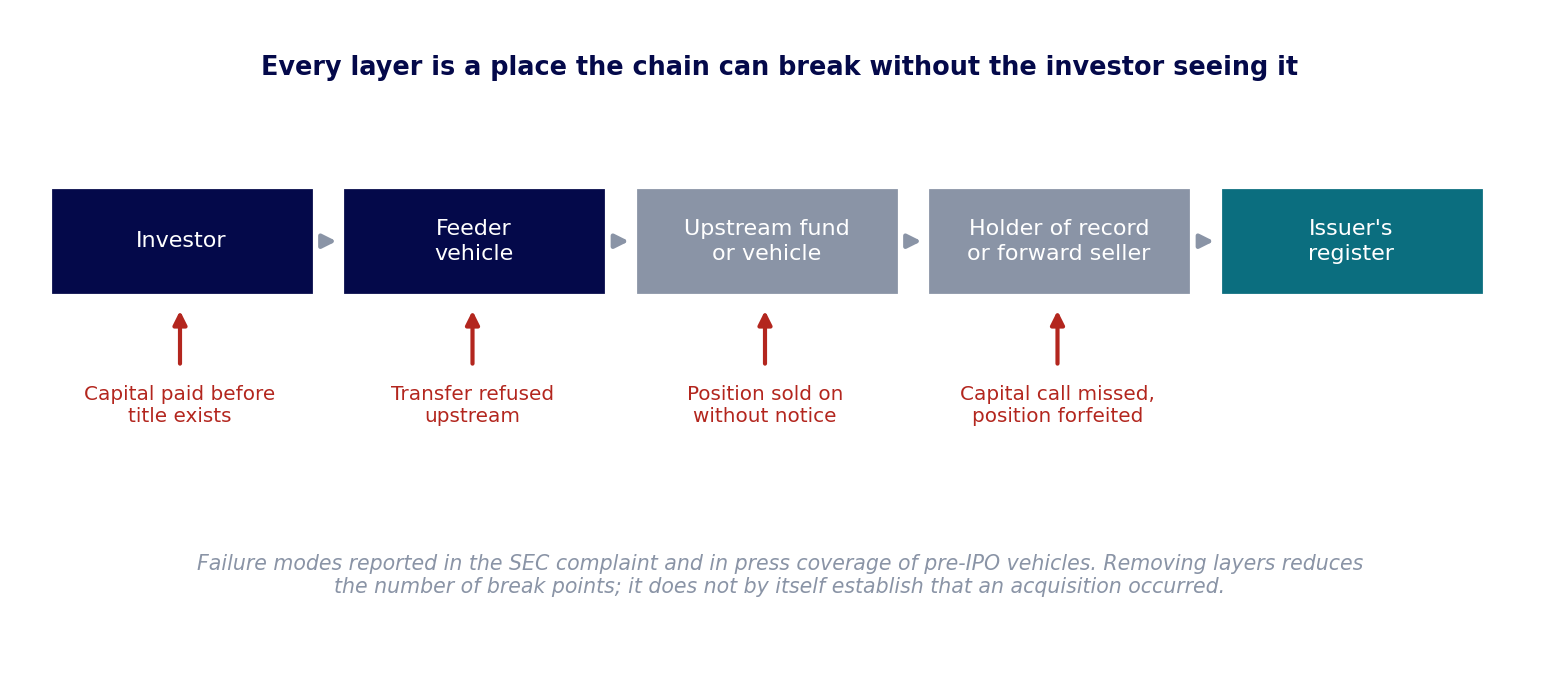
Source: Argent Bluebook, based on failure modes described in the SEC complaint [2] and in press reporting on pre-IPO vehicles [3][5]. Illustrative.
Why it repeats
Four conditions recur, and they are structural rather than moral.
- Scarcity makes buyers compliant. When access to a named company is the product, the buyer who asks awkward questions risks losing the allocation. Diligence standards fall exactly when demand is strongest.
- Confidentiality is a usable excuse. Genuine secondary transactions are discreet, and issuers do not confirm holdings to third parties. That norm is legitimate — and indistinguishable, from the buyer's seat, from a manager who cannot produce proof because none exists.
- There is no record the investor can reach. Public-market investors hold positions confirmed by someone other than the person who sold them. In these structures the only account of what happened is the one the manager writes.
- Discovery is deferred to the exit. A fund can be empty for two years and look healthy, because the thing that would reveal it — a liquidity event — has not arrived. The SpaceX listing is why several of these cases surfaced in the same quarter.
Add one more, specific to this market: these advisers often sit outside routine examination. The firm in this complaint reported exempt reporting adviser status and at most US$34m in regulatory assets under management [2]. The investor protections people assume are present frequently are not.
| Failure | What the investor sees | When it surfaces |
|---|---|---|
| The acquisition never completes | Confirmation that the deal has closed, then statements showing gains | At the liquidity event, or when an investor engages counsel |
| The position is sold on without notice | Nothing — reporting continues unchanged | At the IPO, when distributions do not arrive |
| An obligation is missed and the position is forfeited | Nothing; in one case, newly issued certificates in an empty fund | After the forfeiture is already final |
What this is not an argument against
It would be easy to conclude that pooled vehicles are the problem. That does not survive the facts. A vehicle is how a group of investors appears once on a register the issuer wants kept short, and the better-run ones do that job properly. In the fund described above, a single-tier structure would have failed identically, because the defect was not the number of layers: an acquisition was represented as complete when the counterparty had refused it, and nobody on the buying side could tell.
Layers do matter — each adds a place where title can be lost quietly. But removing layers without adding verification produces a shorter chain that still rests on the manager's word.
The useful question is not which wrapper an investor used, but whether anyone outside the manager's office could have established, when the money moved, that the position existed and was held for them. In each of these cases the answer was no. A companion note will consider what fixing that would require.